
Your Guide to Buttered Bread Calories
Curious about buttered bread calories? Learn what's in your favorite snack and discover how to track it without the stress, making mindfulness easy.
Posted by
 Munchlog
Related reading
Calories in Purple Onions and How to Track Them Stress-Free
Discover the calories in purple onion (raw vs cooked) and learn simple, stress-free ways to track them for a balanced diet. Your guide to mindful eating.
How Many Calories in 2 Sunny Side Up Eggs? Your Breakfast Guide
Discover 2 sunny side up eggs calories with a simple nutrition breakdown and tips to track your breakfast effortlessly.
Your Simple Guide to Using a Macro Calorie Tracker
Learn how a macro calorie tracker can help you understand your diet without the stress. Track protein, carbs, and fats to reach your wellness goals easily.
A simple slice of buttered white bread? You're looking at about 103 calories. It’s a classic comfort food for a reason, perfect for a quick breakfast or a cozy snack.
How Many Calories Are in Buttered Bread?
Buttered bread is one of those simple pleasures in life. It's quick, easy, and always hits the spot. But if you're trying to be a bit more mindful of your nutrition, you've probably wondered how it fits into your day. The good news? You don’t have to ditch it. You just need to know the numbers.
This snack is a staple, but its final calorie count really comes down to the two main players: the bread and the butter. On average, a typical slice of white bread (around 25 grams) contains about 67 calories. A standard pat of butter—roughly a teaspoon or 5 grams—adds another 36 calories.
A Quick Calorie Breakdown
This chart gives you a clear visual of where the calories come from in a standard slice.
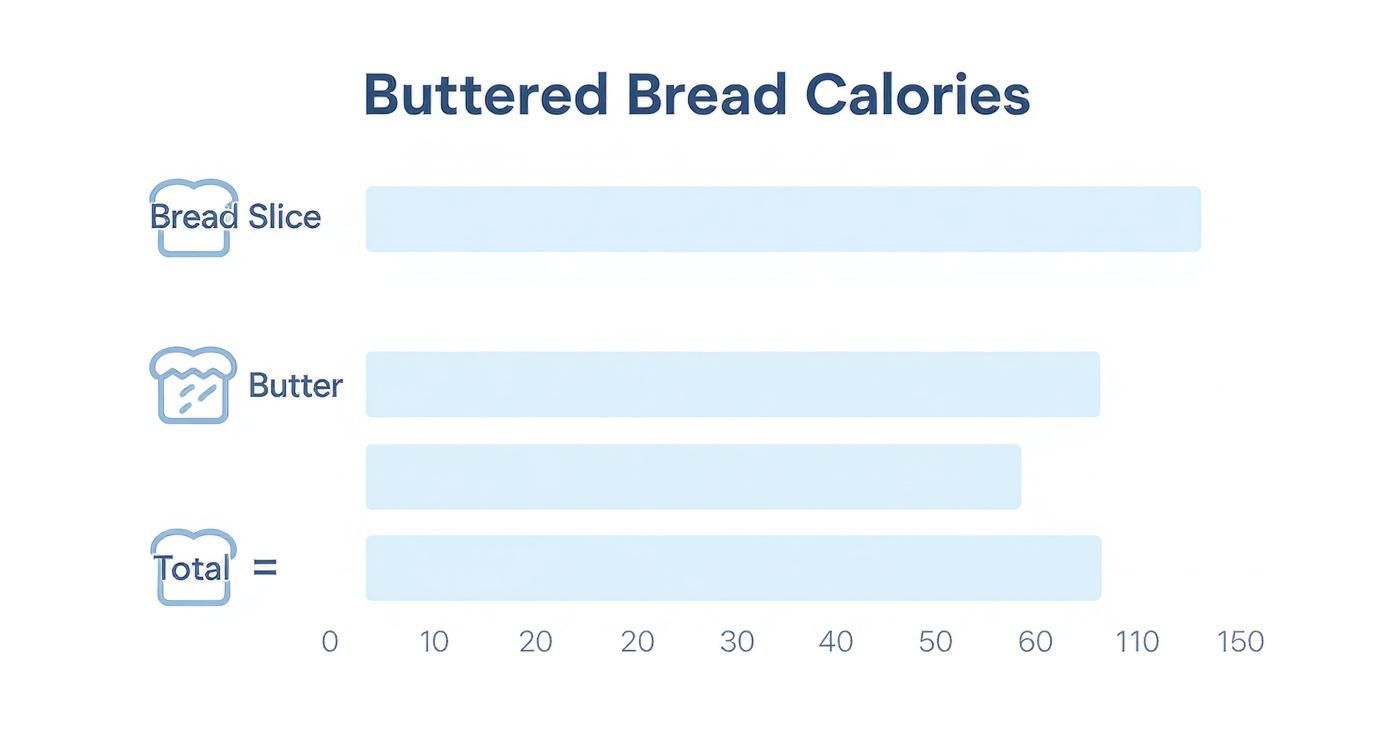
As you can see, the bread itself makes up most of the calorie count, mainly from carbs. The butter’s contribution is almost all fat. This kind of breakdown is common for lots of foods—for instance, you can see a different profile when you look at the calories in chapatis. Understanding these simple components makes logging your meals with an app like Munchlog.ai way less of a chore.
Quick Guide to Buttered Bread Calories
To make things even easier, here's a quick reference table for common bread types. The numbers assume one standard slice with a single teaspoon (~5g) of butter.
| Bread Type | Estimated Total Calories | Protein (g) | Carbs (g) | Fat (g) |
|---|---|---|---|---|
| White Bread | 103 | 2 | 13 | 4 |
| Whole Wheat | 116 | 4 | 14 | 5 |
| Sourdough | 121 | 4 | 19 | 4 |
| Rye Bread | 101 | 3 | 12 | 4 |
Just remember, these are estimates! The exact numbers will always depend on the brand of bread and butter you use, and of course, how generously you spread it.
Why Your Slice Might Have More Calories
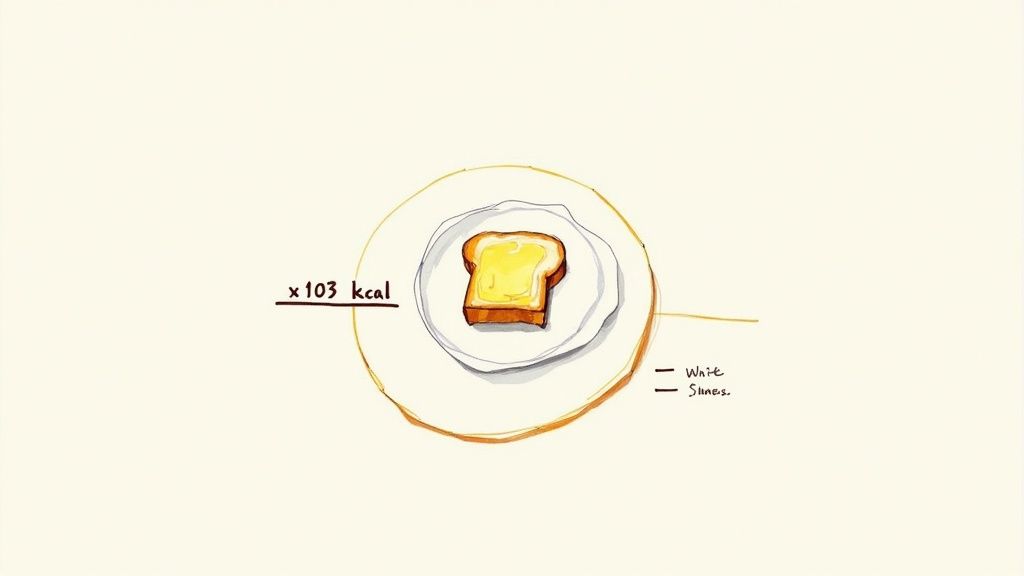
So, is every slice of buttered bread the same? Not even close. That 103-calorie figure is a decent ballpark, but the reality can swing wildly depending on what you’re actually eating. Think of it like coffee—a black Americano is worlds apart from a caramel latte, even though they both start with espresso.
The two things that make the biggest difference are, you guessed it, the bread and the butter. Let's see how each one impacts the final calorie count.
It's All in the Bread and Butter
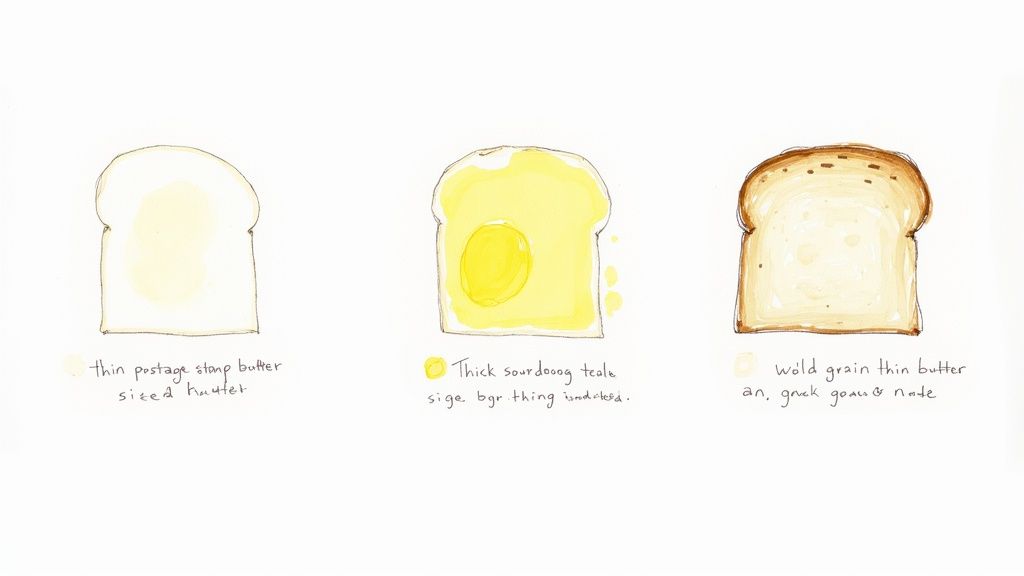
First, the bread itself is a huge factor. A slice of light, fluffy white bread doesn't have the same heft (or calories) as a dense, thick-cut piece of artisan sourdough. The thickness of your slice matters, too. A thin slice might only set you back 80 calories, while a massive "doorstep" slice could easily be double that.
Now for the butter—this is where the numbers can really climb. Butter is almost pure fat, which means it’s very calorie-dense. How much you spread on makes all the difference.
- A Thin Scrape: If you’re just lightly glazing the surface, you might only add 20-30 calories.
- A Generous Layer: But if you’re slathering on a thick layer that melts into every corner, you could easily be adding 100+ calories from the butter alone.
It’s easy to see how a couple of slices of toast can quickly become a 250-calorie snack. No need to stress, just something to be mindful of.
Getting a feel for fats, carbs, and proteins is key to smarter eating. Once you get the hang of it, you can make quick estimates without ever pulling out a food scale.
This is exactly why having a basic understanding of what macronutrients are is so helpful. It’s not about obsessing over every number. It's about developing an intuition for your food, so you can glance at your toast and make a solid guess—perfect for quick logging in an app like Munchlog.
The Easiest Way to Track Your Toast
So, you get the moving parts of buttered bread calories, but let's be real—who has time to manually log every single thing? The thought of searching a database for "whole wheat bread, one slice" and then "butter, salted, one teaspoon" is enough to make anyone give up.
This is where tracking should feel effortless.
Imagine just saying, "Hey Munchlog, I had two slices of whole wheat toast with a little butter." That's it. No typing, no scrolling through endless lists, no second-guessing. The app handles the rest, giving you a solid estimate of the calories and macros in a few seconds.
Making Tracking a Natural Part of Your Day
This conversational approach to food logging removes all the friction that makes most people quit. Traditional tracking apps can feel rigid, almost demanding precise measurements. While that level of detail has its place—as we cover in our guide on how to weigh food for weight loss—it's often overkill if your goal is just to stay mindful.
Voice tracking fits right into your day. Just finished breakfast? Log it while your coffee is brewing. Grabbed a quick snack at your desk? You can speak your entry without breaking your workflow.
The goal of casual tracking isn't perfect precision—it's consistent awareness. By making logging as easy as talking, you build a sustainable habit without the stress.
This method is a game-changer for anyone who just wants to keep an eye on their nutrition without it taking over their life. Here’s why it works so well:
- It’s Fast: Logging takes seconds, not minutes.
- It’s Intuitive: You just describe your food naturally, like you'd tell a friend what you ate.
- It’s Stress-Free: Forget about perfection. The goal is to get a good-enough picture of your daily intake.
For instance, you could say, "I had a thick slice of sourdough toast with a generous amount of butter and jam." The AI gets the context and provides a reasonable estimate. It’s all about making smarter choices, not chasing flawless numbers, and finally turning tracking from a chore into a simple habit.
Smarter Swaps for Your Buttered Bread
https://www.youtube.com/embed/xLZmXiHma_8
Let's be clear: you don't have to give up your beloved buttered toast. But if you're looking for ways to lighten the calorie load without sacrificing that satisfying crunch, a few simple swaps can make a big difference. The idea isn't to force-feed yourself a bland substitute, but to find new combos you genuinely enjoy.
Making a few small tweaks to your bread or spread can completely change the calorie count. These little adjustments add up, helping you reach your goals without feeling like you're on a miserable diet.
Simple Spread Swaps
Instead of a thick layer of regular butter, why not give one of these a try?
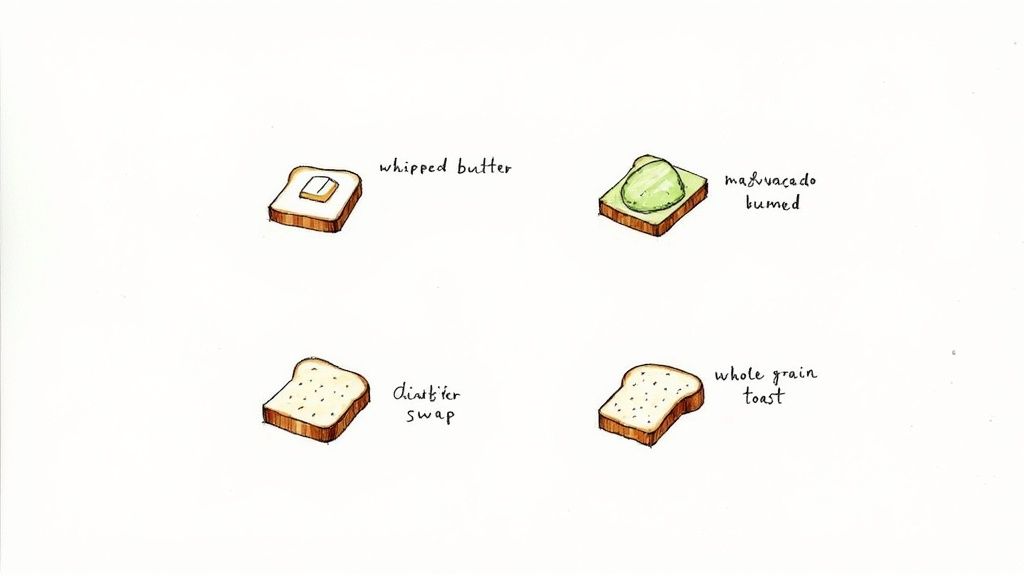
- Whipped Butter: This stuff is lighter and fluffier because it's been whipped with air. That means you get less fat and fewer calories in the same spoonful, but all the same buttery flavor.
- Mashed Avocado: A quarter of an avocado gives you a dose of healthy fats and fiber. It's got a fantastic creamy texture for a calorie count that’s similar to a standard pat of butter.
- Hummus or Greek Yogurt: If you're in a savory mood, both of these are great options that add a little protein. A tablespoon of hummus, for instance, is only about 25-30 calories.
These alternatives not only bring new flavors to the table but also boost the nutritional value of your toast. Plus, they’re incredibly easy to log with a quick voice command, like, "I had one slice of toast with avocado."
Better Bread Choices
The bread itself is half the equation. Swapping your usual slice for a carb-smart high-protein bread can be a game-changer, giving you a much lower calorie base to start with. Thin-sliced whole grain or a light rye are also fantastic choices that pack in more fiber, which is great for keeping you feeling full longer.
It’s no secret we love our bread—in fact, 78% of consumers bought bread products just last year. It’s a global staple for a reason. By simply choosing a loaf that aligns better with your goals, you're making an effortless but effective change.
How Buttered Bread Fits into Your Day
So, where does a simple slice of buttered toast actually fit into your daily life? We've talked numbers and smart swaps, but the real key is understanding context. It's easy to get bogged down in whether a food is "good" or "bad," but that's not really how nutrition works.
Think of your daily food intake like a budget. A slice of toast isn't a huge expense that ruins everything; it's just one line item. Seeing it this way helps strip away the guilt and makes food tracking feel less like a chore and more like a helpful tool.
Putting It All Together
Let's imagine how this plays out for a couple of people. A busy professional might start their morning by logging, "Sourdough toast with butter and a scrambled egg." It's a quick, balanced breakfast that provides the carbs, fat, and protein needed to get the day rolling.
Or think about a student grabbing a snack between classes. A couple of slices of white toast with butter is a fast, comforting energy boost. By quickly logging it, they know they've added about 200 calories and can factor that into their dinner choice later on—no stress, just awareness.
The goal isn’t perfect eating; it’s mindful eating. When you track your food casually, you start to naturally see how everything fits together. That empowers you to make balanced choices without obsessing.
This is exactly the philosophy we built into Munchlog. By making food logging as easy as talking, it shifts the focus from anxiety to awareness. You can still enjoy the foods you love—like a warm piece of buttered bread—and hit your goals because you have a clear, guilt-free view of your daily nutrition. It’s all about finding balance, not banning your favorites.
Common Questions About Bread and Calories
When you start paying attention to what you eat, even something as simple as buttered bread can bring up a lot of questions. Let's tackle some of the most common ones with clear, practical answers.
Is Whole Wheat Really Better Than White Bread?
Ah, the classic bread debate. The truth is, it's not as black and white as you might think. Whole wheat bread generally has more fiber and a few more nutrients, which can help you feel full longer. That’s a definite win.
But that doesn't make white bread "bad." A slice of white toast can absolutely be part of a healthy diet. It all comes down to the big picture. If the rest of your day is filled with fiber from veggies and other whole grains, that piece of white toast isn't going to make or break your progress.
How Accurate Is Tracking With My Voice?
It's fair to be a little skeptical—can just talking to an app really be accurate? The cool thing about a voice-powered tool like Munchlog is how it understands natural language. You don't have to be a nutritionist to use it. You just say what you ate, like, "a thick slice of toast with a little butter."
The AI uses a massive food database to translate your everyday words into a solid nutritional estimate. Is it as precise as weighing every ingredient on a food scale? Nope. But for most of us, that's not the point. It’s more than accurate enough for building awareness and staying on track without the obsessive hassle.
No single food will make you gain weight. It always comes down to your overall calorie balance—the total energy you consume versus what you burn throughout the day.
Will Eating Buttered Bread Make Me Gain Weight?
Let’s clear this one up: no, buttered bread on its own will not make you gain weight. It's a myth that specific foods are uniquely "fattening." Weight gain happens when you consistently eat more calories than your body uses over time.
A slice of buttered toast is just one small part of your day. You can absolutely enjoy it and still maintain a healthy lifestyle. As long as you’re mindful of your total intake, there’s always room for the foods you love. It’s about balance, not restriction.
Ready to make tracking feel effortless? With munchlog.ai, you can log your meals just by talking. Stop typing and start living. Try it today!