
How Many Calories in Bread and Butter? (It's More Than You Think)
Curious about calories in bread butter? This clear guide breaks down the numbers for different bread types and shows you how to track snacks with ease.
Posted by
 Munchlog
Related reading
Voice food logging vs photo food logging: a practical decision matrix
Compare voice food log apps and photo food diaries for friction, privacy, accuracy, and habit-building. Practical tips to pick a low-shame, lasting approach.
The Real Scoop on Calories in Air Fried Chicken Breast
Discover the true calories in air fried chicken breast and learn how simple recipe changes affect your macros. Find out how easy it is to track your meals.
What Is a Calorie Deficit? A Stress-Free Guide to How It Works
what is calorie deficit diet: discover how it works, how to calculate your deficit, and tips to start without stress.
Ever pause before slathering butter on a warm slice of bread and wonder, "how many calories are really in this?" It’s a classic comfort food, but the numbers can add up faster than you might think. A single slice of white bread with a standard pat of butter typically lands somewhere between 137 and 152 calories.
This humble snack is the perfect example of how small, delicious additions contribute to your day. Let's break it down, no stress involved.
Your Quick Guide to Bread and Butter Calories
So, where do those calories actually come from? It’s a simple team-up: carbohydrates from the bread and fat from the butter. Together, they deliver a quick burst of energy.
A typical slice of store-bought white bread has about 65 to 80 calories. When you spread on a standard 10-gram pat of butter (about the size of a small hotel packet), you’re adding another 72 calories right on top.
If you’re casually aiming for around 2,000 calories a day, this quick bite can account for 7–8% of your daily total. It's not a big deal, but it's handy to know! You can learn more about butter's role in diets worldwide for a broader perspective.
This simple chart shows you how it all stacks up.
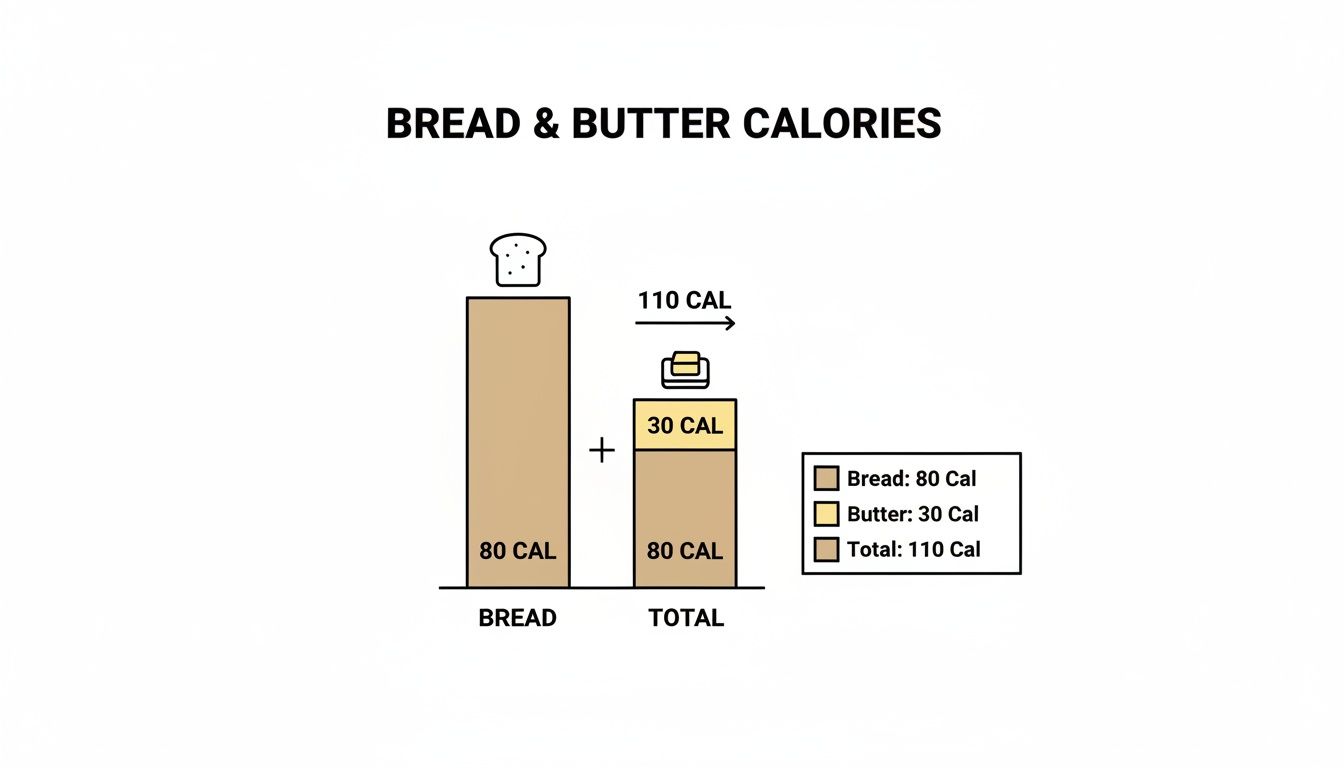
As you can see, the butter is a major player. It’s a great reminder that spreads and toppings can easily double the calories of a light snack. Just being aware of this helps you make mindful choices without getting bogged down in strict counting.
Why Not All Bread and Butter Is Created Equal
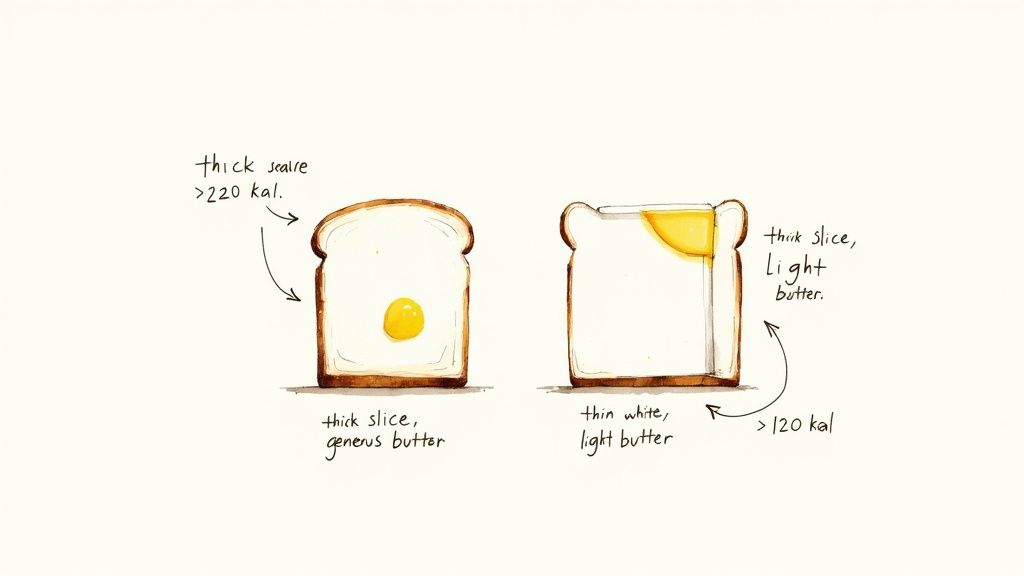
Ever grab a thick slice from a bakery loaf and notice how much more satisfying it is than a pre-packaged slice? Or see how one person’s “pat of butter” is a paper-thin scrape, while another’s is a thick, melty slab? This is the key—not all bread and butter is the same, and the calorie count can swing wildly.
Think of it this way: a slice of standard, airy white bread is like a compact car, while a dense, chewy slice of artisan sourdough is an SUV. They're both "one slice," but they have different weights and, therefore, different calorie loads. The same goes for butter. A light smear might only add 30-40 calories, but a generous, restaurant-style portion can easily tack on over 100 calories.
The Big Variables: Slice and Spread
When you get down to it, two simple things dictate the final calorie count:
- Slice Weight: Your typical store-bought slice is usually around 25-30 grams. But a slice you cut yourself from a crusty, homemade loaf? That could easily be double the weight, meaning double the calories.
- Butter Portion: This is the real wildcard. Butter is incredibly calorie-dense, so the amount you use makes a huge difference.
The global butter industry is massive for a reason—it's an energy-rich staple. A standard 250g block of butter packs a punch, containing anywhere from 1,800 to 2,250 calories. This context shows just how quickly a "small" pat can contribute to your daily intake. You can find more insights on the global butter market on fortunebusinessinsights.com.
Developing Your Eyeballing Skill
Learning to eyeball these differences is a game-changer. You don't need a food scale every time you make toast. It's more about building an intuitive sense of portion sizes. Even factors like using one of the many gluten-free breadmakers can change the density and nutritional profile of your bread.
The goal isn't perfection; it's awareness. Simply recognizing whether you're dealing with a "heavy" slice or a "scrape" of butter helps you make a much more accurate mental note. It's the kind of detail you can easily capture by saying it out loud to an app like munchlog.ai, helping you stay on track without the obsession.
How to Log Your Snack in Seconds with Your Voice
So, you’ve made your toast and have a good guess at the calories. Now what? Let's be honest, this is where most of us give up. Opening an app, searching for "whole wheat bread," then "butter," and typing in the amounts feels like way too much work for a simple snack.
This is exactly where voice logging comes in and completely changes the game. It connects your intention to be mindful of your food with the reality of a busy life.
Making Tracking Effortless
Imagine just saying what you ate: "I had a slice of whole wheat toast with butter." That's it. An app like munchlog.ai can take that simple spoken phrase and intelligently log the items for you. No typing, no searching, and zero stress.
This approach is designed for real life, not a perfect world where you have time to weigh and measure everything. It's about making tracking feel as natural as talking.
The real power of food logging isn't just about data—it's about staying aware of your nutrition without disrupting your life. When tracking is as easy as talking, it stops being a chore and becomes a simple, sustainable habit.
For anyone on an iPhone, getting good at voice to text on iPhone can make this even quicker. The whole point is to remove as much friction as possible.
Using your voice also lets you capture those little details—like a "thick slice" or "just a little butter"—that create a more accurate picture. This is what makes for an easy food tracking app that you'll actually stick with. You get all the benefits of awareness without any of the tedious data entry.
Looking Beyond Calories at Your Snack's Macros
While calories give you a quick energy snapshot, they don't tell the whole story. To really understand your food, it helps to look at macronutrients—or "macros." These are the big three your body runs on: carbohydrates, protein, and fat.
Thinking about bread and butter this way is pretty simple. Your slice of bread? That's almost all carbohydrates, your body's go-to fuel source. It powers everything from a morning walk to just thinking straight at your desk.
The butter, on the other hand, is nearly 100% fat. Fats are essential too, providing long-lasting energy and helping your body absorb certain vitamins. Put them together, and you've got a snack that delivers carbs and fat, but not much protein. This isn’t good or bad—it’s just useful info for balancing out the rest of your day. For a deeper dive, our guide on what macros in food are is a great place to start.
A Quick Comparison of Macros in Bread vs Butter
Let's see where the macros in your snack come from. This simple comparison shows the different roles bread and butter play.
| Food Item | Primary Macronutrient | Approximate Carbs (g) | Approximate Fat (g) | Approximate Protein (g) |
|---|---|---|---|---|
| White Bread (1 Slice) | Carbohydrates | 15 g | 1 g | 3 g |
| Whole Wheat Bread (1 Slice) | Carbohydrates | 14 g | 1 g | 4 g |
| Butter (1 Tbsp) | Fat | 0 g | 12 g | 0.1 g |
The takeaway is pretty clear.
That little schmear of butter is what completely changes the nutritional profile of your toast, adding a lot of fat without adding any meaningful carbs or protein.
Once you get this, you can start making smarter food pairings on the fly. Knowing your toast is mostly carbs and fat, you might decide to throw a scrambled egg on top for a protein boost. It’s these small, informed tweaks that build a balanced diet over time. And tracking it all with a quick voice note in munchlog.ai makes it simple to see how it all adds up.
Smart Swaps and Portion Tips for Mindful Eating
Loving bread and butter doesn't mean you have to give it up. It’s all about making a few small tweaks that feel easy and sustainable. Think of it less like a diet and more like being a little more mindful.
A great place to start is with the bread itself. Simply choosing a 100% whole-grain or seeded bread instead of white bread gives you a nice fiber boost. That extra fiber helps you feel fuller for longer, which is always a win.
Lighter Spreads and Smarter Portions
Now, let's talk butter. Since it packs so many calories into a small amount, even a tiny change makes a big difference. You could try a whipped butter, which has more air in it, making it naturally lighter in calories per spoonful. Or, you could explore new spreads.
Here are a few simple swaps to try:
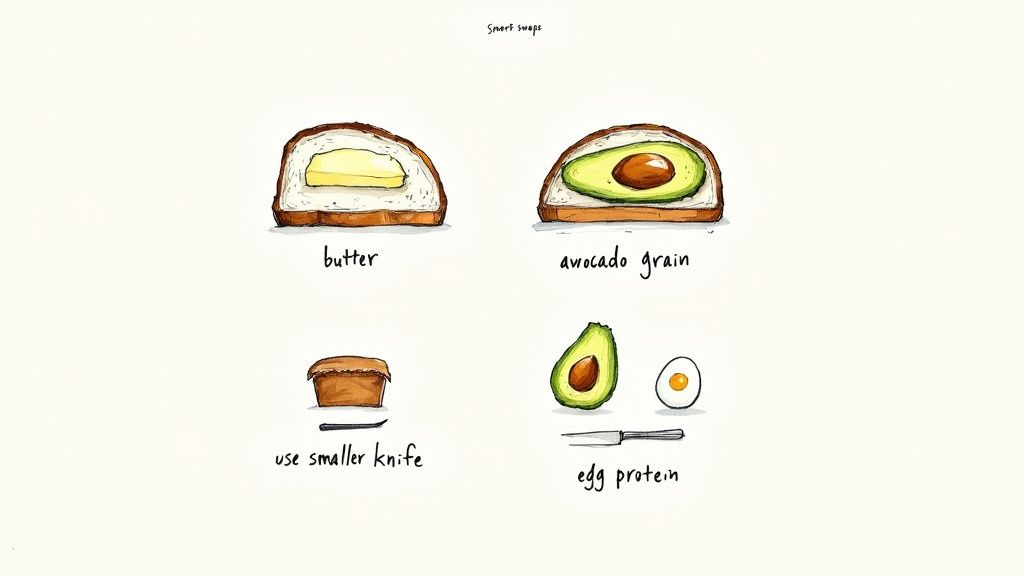
- Avocado: Mashing up a quarter of an avocado gives you that creamy, satisfying texture plus healthy fats and fiber.
- Hummus: A layer of hummus adds a savory kick and a little plant-based protein.
- Greek Yogurt: It might sound odd, but a smear of plain Greek yogurt with a sprinkle of everything bagel seasoning is delicious and packed with protein.
Portion control is another powerful tool. One of the easiest tricks is to use a smaller knife or even the back of a spoon to spread your butter. This simple move makes it much harder to accidentally pile on an extra 100 calories.
The key to sustainable eating habits isn't about drastic cuts or eliminating foods you love. It’s about building awareness and making small, consistent adjustments that add up over time.
Balancing Your Plate for Better Results
Finally, think about what else is on the plate. Since bread and butter is mostly carbs and fat, adding a source of protein can make your snack much more satisfying. For example, topping your toast with a scrambled or fried egg adds about 6 grams of high-quality protein.
That little addition helps balance the macros, keeping you feeling full and energized for much longer. It's a simple strategy to turn a quick bite into a more complete mini-meal.
For those who want to dial in their accuracy without stress, you can find more tips in our guide on how to weigh food for weight loss. And remember, all these swaps are easy to log with a quick voice note in munchlog.ai.
Got Questions About Bread and Butter? Let's Dig In.
It's totally normal to have questions when you start paying attention to the little details in everyday foods. Let's clear up a few of the most common ones so you can feel good about your toast.
Sometimes the simplest questions are the most important ones.
Is Whole Wheat Bread Really Better Than White Bread?
If you're just looking at calories, the difference is tiny. A slice of whole wheat and a slice of white bread are often only 5-10 calories apart.
The real advantage of whole wheat is its higher fiber content. Fiber is a game-changer for feeling full and satisfied, and it's great for digestive health. So, even if the calorie count is nearly the same, whole wheat gives you more nutritional bang for your buck.
Does Toasting Bread Reduce Its Calories?
This is a classic kitchen myth! Toasting bread doesn't magically make calories disappear.
Toasting causes a chemical process called the Maillard reaction—that's what creates that amazing smell and browned color. A tiny bit of water evaporates, so the slice weighs a fraction less, but the calorie change is basically zero. You can log your toast just like a regular slice of bread.
Don't sweat the small stuff, like whether toasting changes the calorie count. The things that really move the needle are your portion sizes of both the bread and the butter.
How Can I Estimate Butter Portions Without a Scale?
Nobody wants to pull out a food scale for their morning toast. Luckily, you don't have to. The key is to use simple visual cues.
Think of a standard teaspoon of butter (around 5 grams) as being about the size of a postage stamp. A tablespoon (around 15 grams) is closer to the size of the tip of your thumb. These little tricks make estimating quick and easy.
And if you want it to be even more effortless, you can just tell munchlog.ai, "I had a slice of toast with a postage stamp-sized pat of butter," and let our AI figure it out for you.
Tired of guessing? With munchlog.ai, all you have to do is say what you ate. Let our AI handle the tracking. See how easy mindful eating can be by visiting https://munchlog.ai today.