
how many calories are in boiled chicken breast | A Simple Guide
Find out how many calories are in boiled chicken breast and how it fits into a balanced diet. Get portion tips and nutrition insights.
Posted by
 Munchlog
Related reading
How Many Calories in 2 Sunny Side Up Eggs? Your Breakfast Guide
Discover 2 sunny side up eggs calories with a simple nutrition breakdown and tips to track your breakfast effortlessly.
How Many Calories in Bread and Butter? (It's More Than You Think)
Curious about calories in bread butter? This clear guide breaks down the numbers for different bread types and shows you how to track snacks with ease.
Your Simple Guide to Using a Macro Calorie Tracker
Learn how a macro calorie tracker can help you understand your diet without the stress. Track protein, carbs, and fats to reach your wellness goals easily.
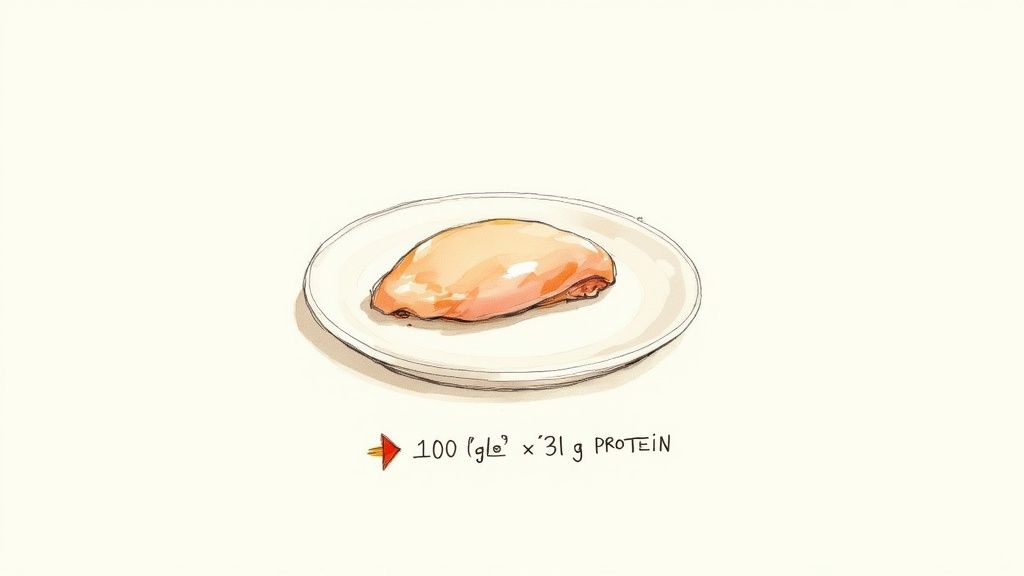
So you're wondering about boiled chicken breast. Let's get right to it. A standard 100-gram (about 3.5 ounces) serving of boneless, skinless boiled chicken breast has roughly 165 calories. It's a clean, lean protein source, making it a go-to for healthy meals without any extra fuss or fat.
Your Quick Guide to Boiled Chicken Calories
When you're trying to eat a bit better, boiled chicken breast almost always makes the list. It’s simple, super versatile, and packed with the good stuff that helps you feel full and satisfied. But trying to nail down the exact numbers can feel like a chore, and that’s where the idea of "casual tracking" really shines.
The goal isn't to get lost in complicated spreadsheets. It's about having a general idea of what you're eating. This approach helps you make smarter choices without getting bogged down by every single calorie. You’re just trying to be a bit more mindful, not training for a fitness competition.
A Simple Numbers Breakdown
Boiled chicken breast is one of the most efficient protein sources you can find. A huge 80 percent of its calories come directly from protein. In a typical 100-gram serving, you're getting about 31 grams of high-quality protein, which is fantastic for everything from muscle repair to keeping hunger away. You can find more details on chicken's nutritional profile over at MedicineNet.
Thinking in terms of real-world portions is also way more useful than getting hung up on grams. A small chicken breast you might slice over a salad is probably around 4 ounces, whereas a larger one for dinner could easily be 6 ounces or more.
The key isn't perfection; it's consistency. Having a rough estimate is so much better than not tracking at all because it feels too complicated.
To make things even easier, here’s a quick-reference table breaking down the calories and protein for common portion sizes.
Boiled Chicken Breast At-a-Glance Nutrition
This table provides a great starting point for estimating the nutritional value of boneless, skinless boiled chicken breast.
| Portion Size (Cooked) | Approximate Calories | Approximate Protein (g) |
|---|---|---|
| 3 oz (85g) | 140 | 26g |
| 4 oz (113g) | 187 | 35g |
| 6 oz (170g) | 281 | 53g |
| 8 oz (227g) | 374 | 70g |
Keep this table handy, but remember that the beauty of a voice-logging app like Munchlog is that you don't even have to memorize these numbers.
You can just speak naturally, saying something like, "For lunch, I had a medium boiled chicken breast with some rice," and the AI does the heavy lifting for you. It turns your casual observation into a useful log entry, making mindful eating feel like a seamless part of your day.
Why Does Cooked Chicken Have More Calories Than Raw?
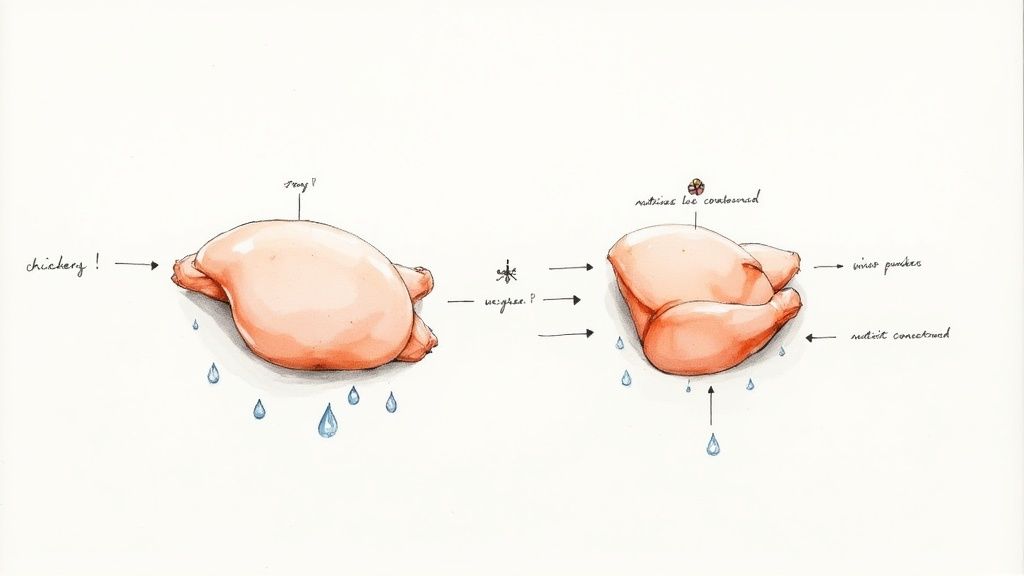
If you've ever glanced at the nutrition label on a pack of raw chicken, then searched for the calories in cooked chicken, you’ve probably scratched your head. Why the huge difference? It seems weird, but there’s a simple explanation. It all comes down to water.
When you boil chicken, it shrinks. The heat forces a good chunk of its water content out, but the important stuff—the protein, fat, and calories—stays behind. This means the final cooked product is much more nutritionally dense, ounce for ounce.
Think of it like making raisins from grapes. You start with a big bunch of juicy grapes, but after they dry out, you're left with a small, dense handful of raisins. The portion is smaller, but all the sugar and calories are now concentrated. Boiled chicken works the same way. A 100-gram serving of cooked chicken breast simply has more actual chicken in it than 100 grams of raw chicken, because a lot of that raw weight is just water.
The Science of Shrinkage
This change isn't trivial. Compared to raw chicken breast, which has around 112 calories per 100 grams, boiling concentrates the nutrients significantly. The process results in a caloric density increase of roughly 47 percent. If you want to dive deeper into the science of it, you can discover more about chicken's nutritional changes on MedicineNet.com.
So, if you weigh your chicken after you’ve boiled it, you're measuring a much more concentrated source of calories and protein. For anyone tracking their food, this is a super important detail for getting your numbers right.
Don’t Get Bogged Down by the Math: All you really need to remember is that cooked and raw weights aren't the same. You don't need to get out a calculator and figure out the water loss yourself—that’s exactly what modern tracking apps were created for.
How to Log It Effortlessly
This is where a casual, no-stress approach to tracking really shines. Agonizing over raw-to-cooked weight conversions is exactly the kind of tedious task that makes people give up on logging their food. It just feels like too much homework for a simple meal.
The best way to handle this is to simply log what's on your plate. If you ate boiled chicken, tell your app you ate boiled chicken. A smart logging tool like Munchlog is designed for exactly this. When you just say, “I had about four ounces of boiled chicken,” its AI gets it.
It automatically pulls the right nutritional info for cooked chicken, giving you a solid estimate without you ever having to think about water loss or conversions. It’s about logging your meal the way you’d describe it to a friend, not the way you’d enter it into a lab report.
A Simple Guide to Chicken Breast Nutrition
So, we've nailed down the calories, but what's actually in that boiled chicken breast? Let's talk macros—the protein, fat, and carbs that make up your food.
Boiled chicken breast is a true protein superstar. It’s got very little fat and practically zero carbohydrates. This is the magic combo that helps you feel full and satisfied long after you eat, making it a fantastic choice for managing hunger without racking up calories.
Of course, not all parts of the chicken are created equal. While all chicken packs a protein punch, the fat content can really vary from one cut to another.
Why Chicken Breast Is the Leanest Choice
Let's compare the chicken breast to its popular cousins: the thigh and the wing. Dark meat, like what you find in chicken thighs, is known for being juicier and more tender. That extra flavor and moisture? It comes from a higher fat content. Wings are even higher in fat, largely because they have so much skin.
The nutritional profile of boiled chicken breast is what makes it the gold standard for lean protein. A 100-gram serving contains only about 3.6 grams of fat. This means just 20% of its 165 calories come from fat, with the rest being almost pure protein. You can explore more data on this at FatSecret.
To really see the difference, let’s put the numbers side-by-side.
Chicken Breast vs. Thigh vs. Wing (per 100g Boiled)
| Chicken Part | Approx. Calories | Protein (g) | Fat (g) |
|---|---|---|---|
| Breast (100g) | 165 | 31g | 3.6g |
| Thigh (100g) | 209 | 26g | 10.9g |
| Wing (100g) | 203 | 30g | 8.1g |
The table makes it crystal clear: if your goal is to get the most protein for the fewest calories and fat, the chicken breast is the undisputed winner.
It’s Not About Good vs. Bad: This doesn't mean you should swear off chicken thighs or wings forever! They’re delicious and can easily fit into a balanced lifestyle. It's just about understanding why chicken breast is so often recommended for lean meals.
Knowing this simple distinction helps you make informed choices without obsessing over every detail. If you're weighing the pros and cons, our guide on whether boiled chicken is a healthy choice for you dives even deeper.
When you use a tool like Munchlog, you get this big-picture view instantly. Just say, "I had boiled chicken for dinner," and you'll see your protein intake for the day get a nice, clean boost. No calculators, no stress—just a simple understanding of what you’re eating.
How to Estimate Portion Sizes Without a Scale
Alright, so you’ve got the numbers down and understand the whole raw-versus-cooked thing. But let’s be real—you’re probably not going to start carrying a food scale everywhere you go. This is where learning to "eyeball it" becomes a real superpower for mindful eating. The goal isn't lab-grade precision with every meal; it's to build a relaxed, consistent awareness of what you’re putting on your plate.
The good news is, you already own a fantastic set of measuring tools that you take with you everywhere: your hands. Learning to gauge portion sizes with a few simple visual cues is a total game-changer, turning a tedious task into a quick, simple check-in.
Using Visual Cues for Easy Estimation
This is all about finding relatable, everyday objects to compare your food to. It's a surprisingly effective trick, and the more you practice, the more accurate your estimates will become.
A Deck of Cards or Your Palm: A standard serving of chicken is about 3-4 ounces. Picture a deck of playing cards—that's a pretty good match for the size and thickness of this portion. You can also just use the palm of your hand (not including your fingers). This is the perfect visual for a piece of chicken you'd slice up for a salad.
A Clenched Fist: A larger piece of boiled chicken breast, maybe around 6 ounces, is going to look a lot more like your clenched fist. This is a common size for a chicken breast serving as the main event on your dinner plate.
Your Thumb: Need to estimate something smaller, like a serving of dressing or sauce? The tip of your thumb, from the top knuckle up, is a great stand-in for about one tablespoon.
This simple visual guide helps you get a better feel for different cuts of chicken, which can make it even easier to know what you're looking at.
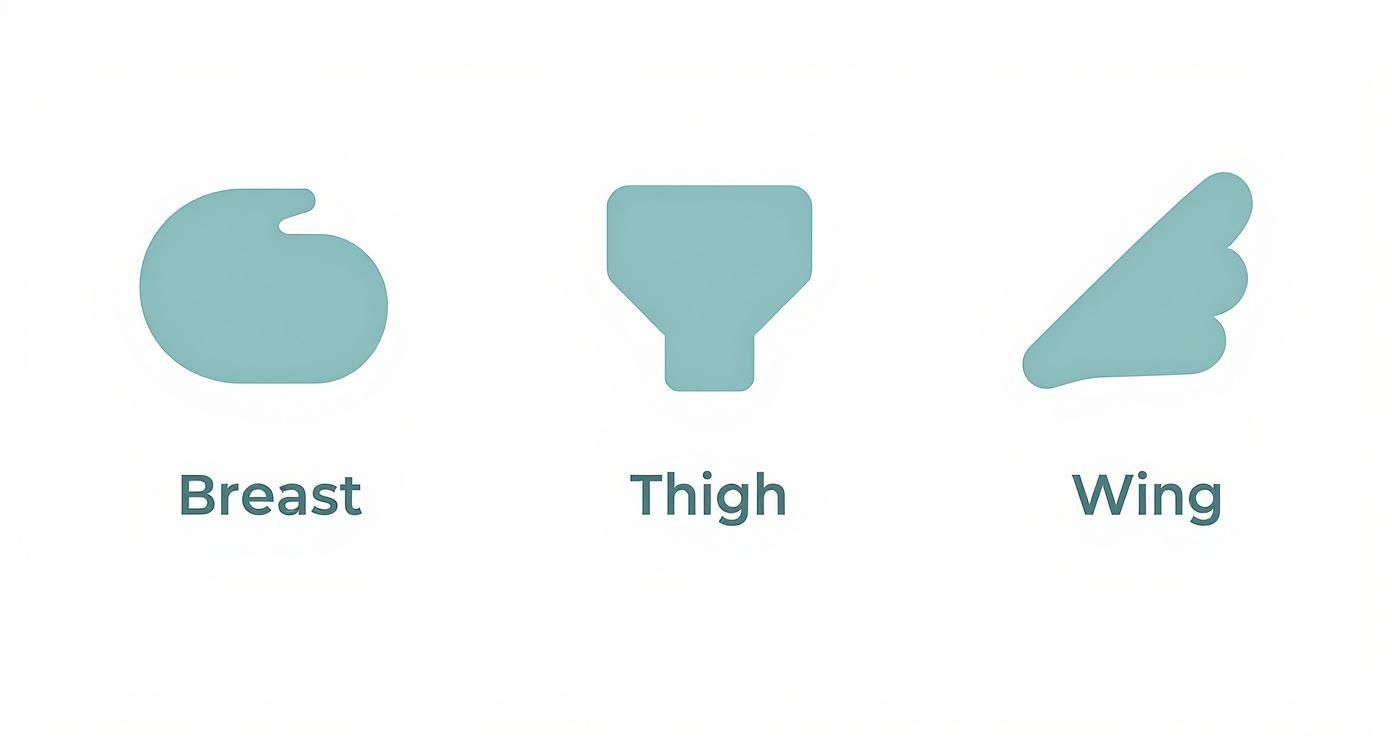
As you can tell, every part of the chicken has a unique shape and size. Once you get used to what a thigh looks like versus a breast, your visual estimates will get sharper and sharper.
Turning Your Estimates into Effortless Logs
Now, here’s where all this estimation skill pays off, especially if you’re using a voice-logging app like Munchlog. You don't have to do the mental gymnastics of converting your visual estimate back into precise numbers. You just say what you see.
Instead of getting bogged down in weighing and calculating, you can simply say, "I had a piece of boiled chicken about the size of my palm for lunch." The AI is smart enough to understand that common reference and translate it into a reliable nutritional estimate for your log.
This approach strips away all the friction. It’s about describing your meals as you eat them, not pausing your life to become a food scientist three times a day. While using a scale has its place for those who want that next level of accuracy—and you can learn more about how to weigh food for weight loss if you're interested—it’s absolutely not a requirement for staying mindful.
Once you’re comfortable eyeballing your portions, you might also find it useful to learn how to scale a recipe. This lets you easily adjust ingredient amounts, whether you're meal-prepping for one or feeding a whole family. It’s all about making nutrition work for your life, not the other way around.
Making Food Logging Feel Like a Conversation
Knowing how to eyeball your boiled chicken is a great skill, but the logging part shouldn't feel like a chore. The whole point of a more relaxed approach to nutrition is making it fit your life, not forcing your life to fit a rigid tracking system. This is where the magic of voice logging comes in—it turns a tedious task into something as simple as sending a voice note.
Imagine you just finished lunch. Instead of fumbling with your phone, opening an app, typing "boiled chicken breast," scrolling through options, and entering the amount, you just... talk. The entire process becomes fluid and intuitive, cutting out all the friction that makes so many people give up on tracking.
Real-Life Logging Scenarios
Let's walk through what this looks like day-to-day. A good logging system should adapt to your meals, not the other way around.
Here are a few examples of how you could log your chicken using a voice-powered app like Munchlog:
- For a Salad: You tossed some leftover boiled chicken into your greens. You can just say, "I had a big salad with about 4 ounces of boiled chicken, spinach, and some vinaigrette." The app sorts out the important details for you.
- For a Homemade Soup: Made a big batch of comforting chicken soup? Just say, "Logged my homemade chicken noodle soup with a handful of boiled chicken, carrots, and celery." It doesn't require perfect measurements, just a natural description.
- For a Quick Wrap: If you threw a wrap together for lunch, you might say, "I had a chicken wrap with a small piece of boiled chicken, lettuce, and a little mayo."
In each of these scenarios, the AI is built to understand how people actually talk about food. It intelligently picks out the items, the estimated amounts, and any other ingredients to create a surprisingly accurate log. The technology behind this is similar to the voice to text software we see in all sorts of modern tools.
The goal is to capture the essence of your meal without getting hung up on perfection. Describing your food out loud is faster, more intuitive, and feels less like a task and more like a simple check-in with yourself.
This conversational method gets to the heart of what modern tracking should be: something that fits into the cracks of a busy day. You shouldn't have to stop everything just to document your meal. You can learn more about this philosophy in our complete guide on how to track calories without the stress. It’s all about making mindful eating an effortless habit, not another item on your to-do list.
Burning Questions About Boiled Chicken Nutrition
Let's clear up a few common questions that pop up when tracking boiled chicken. Getting these answers down will help you log your meals with confidence and really understand how this lean protein fits into your day.
Does Adding Salt or Spices Change the Calories?
This is a great question, and the answer is refreshingly simple: basically, no.
Adding salt, pepper, herbs like rosemary, or calorie-free spices like garlic powder to the water is all about infusing flavor, not adding calories. They make your chicken taste fantastic without messing with the nutritional numbers. The only time this changes is if you toss in something like a bouillon cube (which can have fat or sugar) or douse the finished chicken in a high-calorie sauce.
Is It Better to Weigh Chicken Raw or Cooked for Tracking?
Ah, the classic tracking debate! If you're aiming for absolute precision, the gold standard is to weigh your chicken raw. That’s because the exact amount of water lost during cooking can fluctuate a bit.
But let's be realistic—that's not always practical, especially when you're just trying to log a quick lunch. A far easier approach is to simply weigh it cooked and log it as "boiled chicken." This method is perfectly fine and way less of a headache. The most important thing here is consistency. Just pick one method and stick with it.
An app like Munchlog is built for exactly this kind of real-world scenario. It understands entries for cooked foods, so you don't have to do the mental math. It’s about being mindful, not a mathematician.
What if My Chicken Breast Still Has the Bone In?
Boiling a bone-in chicken breast doesn't change the calories in the meat itself. The only challenge is figuring out how much of the total weight is actually edible.
A solid rule of thumb is that the bone accounts for roughly 20-30% of the total weight. So, if you start with a 10-ounce bone-in breast, you can expect to get about 7 to 8 ounces of meat off it. For an even simpler method, just pull the meat off the bone after cooking and use the palm-of-your-hand trick we talked about earlier to estimate your portion. No scale needed.
How Do Calories Compare to Baked or Grilled Chicken?
Boiling is one of the leanest ways to cook chicken because it requires zero added fats like oil or butter. Baked or grilled chicken can be very similar in calories—a 100g grilled breast is also around 165 calories—but only if you don't add much oil.
Here's where things can change fast: just one tablespoon of olive oil added to the pan or grill tacks on around 120 extra calories. This is why boiling is such a reliable, foolproof way to keep your calorie count low and predictable.
Ready to make tracking feel as easy as talking about your day? With munchlog.ai, you can just say what you ate, and the AI handles the rest. Stop typing and start talking your way to smarter, stress-free nutrition.
Learn more and get started at https://munchlog.ai.