
How to Count Calories Without the Stress
Learn how to count calories easily with practical, mindful tracking tips for sustainable progress toward your goals.
Posted by
 Munchlog
Related reading
The Real Scoop on Calories in Air Fried Chicken Breast
Discover the true calories in air fried chicken breast and learn how simple recipe changes affect your macros. Find out how easy it is to track your meals.
What Is a Calorie Deficit? A Stress-Free Guide to How It Works
what is calorie deficit diet: discover how it works, how to calculate your deficit, and tips to start without stress.
How many calories in a slice of pineapple? A quick guide for easy tracking
How many calories in a slice of pineapple? Find exact counts for fresh, canned, and grilled pineapple, plus simple tips to track it in your meals.
Ever feel like "counting calories" is a chore for fitness pros and spreadsheet lovers? Let's ditch that idea. At its core, it's just about getting to know your food a little better—like learning the difference between premium and regular gas for your car. It's not a strict diet; it's a tool for awareness.
Starting Your Calorie Counting Journey (the Chill Way)
Let's be real, the phrase "counting calories" probably brings to mind kitchen scales, tedious data entry, and a side of guilt. But it doesn't have to be that complicated.
What if you thought of it as just being mindful of what you eat? The goal isn't to hit a perfect number every single day. It's about building awareness around your habits so you can make small, smart choices that help you feel awesome.
Why a Casual Approach Just Works Better
For most of us juggling work, school, or a busy life, a relaxed approach is way more sustainable. You don't need to weigh every single grape or turn down dinner with friends. The real magic comes from consistently getting a general idea of your intake.
This casual style helps you spot patterns you might have otherwise missed. Maybe that 3 p.m. snack is what’s making you feel sluggish, or perhaps that morning latte is packing more of a punch than you thought.
The key is to see calorie counting as a learning tool, not a pass/fail test. It’s about gathering info that helps you understand what your body needs to thrive, without the pressure of perfection.
This shift toward mindful eating is a big reason why digital tools have exploded. The global market for calorie counter apps is expected to hit USD 1,751.5 million in 2024, which shows how many people are looking for an easier way to track.
Of course, a great first step is figuring out how to plan meals without the stress. Setting yourself up for success is half the battle. This is exactly where an app like munchlog.ai comes in—it’s designed to make tracking feel as natural as messaging a friend, so it actually fits into your life.
Finding Your Personal Calorie Target
Before you start tracking, it helps to have a rough idea of your daily calorie target. Don't worry, this isn't about complex formulas or spreadsheets. This is about finding a flexible starting point, not a rigid rule.
Think of it like setting a loose budget. You know the general ballpark you're working with, but you aren't obsessing over every single cent. Your personal calorie goal will shift based on your age, activity level, and what you're trying to achieve—whether that's maintaining your weight, losing a bit, or building muscle.
A Simple Way to Find Your Starting Point
You might have heard the technical terms: Basal Metabolic Rate (BMR) is what your body burns just by being alive, and Total Daily Energy Expenditure (TDEE) adds in your activity. But diving deep into calculators often leads to "analysis paralysis."
In fact, some studies show that when people feel overwhelmed by constant calculations, dropout rates can be as high as 78% in just three months. You can see the data in this report about calorie counting apps. It’s just not sustainable for most of us.
Instead of getting lost in the weeds, let's keep it simple. Here's a quick reference table to give you a ballpark figure.
Quick Guide to Daily Calorie Estimates
Use this table as a starting point to estimate your daily needs. These are general guidelines, not strict rules.
| Activity Level | Description | Estimated Daily Calories (Female) | Estimated Daily Calories (Male) |
|---|---|---|---|
| Sedentary | Little to no exercise; desk job | 1,800 - 2,000 kcal | 2,000 - 2,400 kcal |
| Lightly Active | Light exercise/sports 1-3 days/week | 2,000 - 2,200 kcal | 2,400 - 2,600 kcal |
| Moderately Active | Moderate exercise/sports 3-5 days/week | 2,200 - 2,400 kcal | 2,600 - 2,800 kcal |
| Very Active | Hard exercise/sports 6-7 days a week | 2,400 - 2,800 kcal | 2,800 - 3,200 kcal |
These numbers are just a rough sketch. The most important thing is to listen to your body and see how you feel.
Remember, this number is just a guideline. The real magic happens when you start tracking and see how your body actually responds. You can always adjust your target up or down.
If you'd like a slightly more tailored number without the headache, you can check out our guide on how to calculate daily calorie needs. It breaks things down in a straightforward way.
The goal here is to find a range that feels good for your lifestyle, not one that feels like a full-time job.
Effortless Ways to Track Your Food
This is where counting calories stops feeling like a chore. Forget weighing every single morsel of food—that's just not realistic for most of us. The key is finding simple methods that fit into your actual life.
One of the best tricks is using your own hand as a portion guide. It’s a visual shortcut you always have with you.
Here’s how it works:
- A palm-sized portion is a great estimate for proteins like chicken or fish.
- A cupped hand is perfect for gauging carbs like a scoop of rice or quinoa.
- The size of your thumb is a surprisingly good measure for fats like a serving of peanut butter or salad dressing.
Let Modern Tech Do the Heavy Lifting
While hand estimates are a great start, technology makes food tracking truly effortless today. It's no wonder the market for diet and nutrition apps is projected to hit USD 4.56 billion by 2030. New tech, like AI, is making logging easier than ever, which is a huge reason people are finally able to stick with it. If you're curious, you can explore the market research on diet and nutrition apps.
Setting a good target is the first step. You don't need complicated formulas; it’s really just about understanding a few key pieces of information.
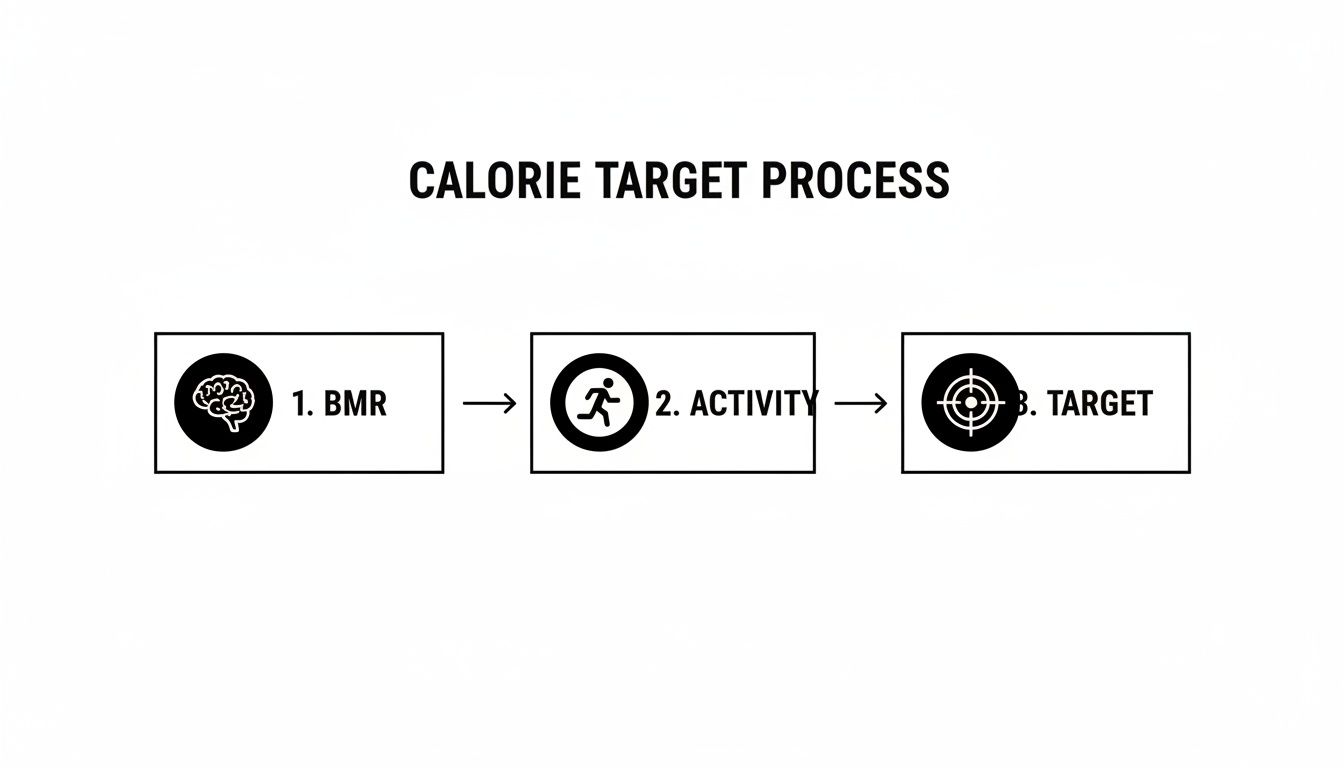
As you can see, your final calorie goal is simply a combination of your body's baseline needs (your BMR) and your daily activity level.
The real game-changer is voice logging. Instead of stopping to type out every detail, you just say, "I had a turkey sandwich with a side salad for lunch," and the app does the rest. It takes seconds.
This completely changes the dynamic. Tracking goes from being a tedious task to a quick, conversational habit. Logging your morning coffee with a splash of oat milk or that homemade spaghetti dinner becomes as simple as sending a voice note. If you want to see how this works, check out our post on finding an easy food tracking app.
Remember, the goal here is consistency over perfection. Logging most of your meals with a reasonable estimate is far more effective than logging a few meals perfectly and then burning out. This relaxed, tech-forward approach is how you build a habit that actually sticks.
Handling Common Food Tracking Challenges
Life doesn’t fit into neat little boxes, and neither do our meals. So, what happens when you’re grabbing dinner with friends or digging into a homemade dish at a family get-together?
It's actually easier than you might think. The secret is to let go of perfection and embrace a more flexible mindset.
The biggest hurdle for most people is restaurant food. With no nutrition label in sight, it can feel like you're guessing. Here’s a simple trick: find a similar dish from a big chain restaurant in your tracking app. If you're eating a burger from a local diner, just log a "cheeseburger" from a national brand. It’s a solid ballpark estimate that keeps you on track.
Another great strategy is to deconstruct your meal. Instead of searching for "chicken stir-fry," try logging the individual ingredients you can see on your plate:
- Grilled chicken breast
- A scoop of white rice
- Mixed vegetables
- A little bit of stir-fry sauce
This approach often gets you a much more accurate estimate.
Navigating Weekends And Social Events
Weekends and parties can feel like a tracking minefield, but they don't have to derail your progress. Ditch the all-or-nothing thinking. One untracked meal or a day that’s a little higher in calories won't undo your hard work. It's the consistency over the long haul that really counts.
The goal isn't perfection; it's awareness. A reasonable guess is always better than skipping tracking altogether. It keeps you engaged and mindful of your choices, even when life gets a little unpredictable.
A little planning goes a long way, too. Knowing your options before you head out can make all the difference. Check out a resource like Apogee Indigo's restaurant directory to get a feel for the menu ahead of time. This helps you walk in with a plan.
And if you’re ever curious about getting super precise at home, our guide on how to weigh food for weight loss has some great tips. But for everyday situations, the goal is to build habits that fit your actual life.
It’s Not Just About the Numbers—Food Quality Matters
Getting a handle on calories is a fantastic starting point, but it's not the whole story. Let's be real: 200 calories of avocado and 200 calories of cookies are going to feel very different in your body. This is where food quality enters the picture.
Thinking about the quality of your food isn't about getting bogged down in science. It’s simply about understanding the three main building blocks—the macronutrients: protein, carbs, and fats. Each one plays a huge role in your energy, fullness, and overall health.
A Quick Guide to Macros
You don’t need to be a nutritionist to get the hang of this. Here’s the simple breakdown:
- Protein: This is what keeps you feeling full and satisfied. It’s also crucial for building and repairing everything from muscles to hair. Think chicken, tofu, beans, and Greek yogurt.
- Carbohydrates: Think of these as your body’s main fuel source. They give your brain and muscles the energy to function at their best. Think fruits, veggies, and whole grains.
- Healthy Fats: Don't fear the fat! These are essential for hormone balance and brain health. Think avocado, nuts, and olive oil.
The real game-changer is when you start connecting the dots between what you eat and how you feel. A balanced plate with a good mix of protein, carbs, and fat will almost always leave you feeling more energized than a meal that’s just one or the other.
The good news is you don't have to do any complicated math yourself. When you log what you eat in an app like munchlog.ai, it automatically breaks down the macros for you. This gives you a clearer picture of your nutrition, empowering you to make smarter choices without any guesswork.
Answering Your Top Calorie Counting Questions
Jumping into calorie tracking for the first time? It's totally normal to have questions. Here are some of the most common ones I hear.
Do I Really Have to Weigh Everything I Eat?
Honestly? No, you absolutely don't. At least, not unless you're a competitive bodybuilder or someone who genuinely enjoys that level of detail.
For most of us, weighing every gram of food is a fast track to burnout. A much more sustainable approach is using visual cues. Use your hand as a portion guide: a palm-sized portion of protein, a fist for carbs, a thumb for fats. It's surprisingly accurate and way less hassle.
Plus, with munchlog.ai, you can just say what you ate. Logging "one medium banana" or "a slice of whole-wheat toast" is as easy as talking to your phone. Remember, the goal here is progress, not perfection.
What About Tracking Calories When I Eat Out?
Ah, the classic question. This one seems tricky, but it's easier than you think. My go-to strategy is to find a similar dish from a big chain restaurant in your app. If you're eating a cheeseburger at your favorite local diner, just log a comparable one from a well-known brand. It'll give you a solid ballpark estimate.
Another trick is to break down your meal into its basic parts. Instead of getting hung up on finding the exact "carne asada burrito" you ordered, just log the components you can see.
- A large flour tortilla
- A scoop of steak
- Some rice and beans
- A spoonful of guacamole
It's always better to make a reasonable guess than to log nothing at all. This keeps you in the habit of being mindful, even when you're not in control of the kitchen.
Will I Have to Count Calories for the Rest of My Life?
Definitely not. Think of tracking as a temporary learning tool, not a life sentence.
For most people, tracking for a few weeks or a couple of months is all it takes. It's an incredible way to learn about portion sizes, see your eating habits clearly, and connect the dots between what you eat and how you feel.
Once you’ve built that awareness, you'll find you don't need to track every meal anymore. The real goal is to use this tool to graduate to a place of effortless, mindful eating.
Ready to start tracking your food without the usual fuss? With munchlog.ai, you just say what you ate, and our AI does the heavy lifting. No typing, no stress—just simple, voice-powered nutrition awareness. Start your journey with munchlog.ai today!