
Your Simple Guide to Using a Macro Calorie Tracker
Learn how a macro calorie tracker can help you understand your diet without the stress. Track protein, carbs, and fats to reach your wellness goals easily.
Posted by
 Munchlog
Related reading
Voice food logging vs photo food logging: a practical decision matrix
Compare voice food log apps and photo food diaries for friction, privacy, accuracy, and habit-building. Practical tips to pick a low-shame, lasting approach.
How Many Calories in Bread and Butter? (It's More Than You Think)
Curious about calories in bread butter? This clear guide breaks down the numbers for different bread types and shows you how to track snacks with ease.
How many calories in a slice of pineapple? A quick guide for easy tracking
How many calories in a slice of pineapple? Find exact counts for fresh, canned, and grilled pineapple, plus simple tips to track it in your meals.
So, what on earth is a macro calorie tracker?
The term itself can sound a bit intimidating, conjuring up images of professional athletes and dietitians with clipboards. But in reality, it’s just a smart food diary that lives on your phone. It goes beyond a simple calorie count to show you where those calories are actually coming from.
Specifically, it tracks your intake of protein, carbohydrates, and fats—the three main macronutrients, or "macros" for short.
What Is a Macro Calorie Tracker, Anyway?

Think of your daily diet as a budget. Calories are your total spending limit. But macros? Macros show you how you’re spending that budget. Are you investing in high-quality fuel, or are you running on fumes?
A simple calorie count tells you the total number of bricks you have to work with. A macro tracker, on the other hand, shows you the different types of bricks you're using—the long ones, the square ones, and the flat ones. To build something that’s both strong and functional, you need the right mix of all three. That’s what a tracker helps you see.
Beyond a Simple Calorie Count
Just counting calories tells you the quantity of energy you're consuming. It’s a useful piece of information, but it's only half the story. It doesn't tell you a thing about the quality of that energy.
That's where macros come in. A tracker fills in those crucial details by showing you the breakdown.
A Quick Look at Macros and Calories
| Macronutrient | Primary Role in Your Body | Calories per Gram |
|---|---|---|
| Protein | The builder—repairs muscle, skin, and organs; keeps you feeling full. | 4 |
| Carbohydrates | The primary fuel source—gives you immediate energy for your brain and body. | 4 |
| Fats | The support system—vital for hormone production, brain health, and vitamin absorption. | 9 |
As you can see, each macro plays a distinct and important role. Knowing your personal breakdown helps connect the dots between what you eat and how you feel.
Feeling that dreaded afternoon slump? You might be running low on quality carbs. Constantly raiding the pantry an hour after a meal? A bit more protein might be what you need. A macro tracker helps you spot these patterns without the stress.
The goal isn't to hit your numbers perfectly every single day. Instead, it’s about gentle awareness—spotting patterns and understanding how different foods make you feel, all without the stress of perfection.
Awareness Without the Obsession
Let's be clear: using a macro calorie tracker isn't about enforcing a rigid diet or slapping "good" and "bad" labels on food. It’s about being curious. It's about building a better understanding of your body. (If you want to dive deeper, we have a simple guide on what macros in food really are.)
At its heart, a macro tracker is a tool for mindfulness. By quickly logging what you eat, you start to notice how your morning coffee, that handful of almonds, or your home-cooked dinner contributes to your overall energy and well-being.
And with modern tools like munchlog.ai, the process is easier than ever. You can log your meals just by talking, which makes it feel less like a chore and more like sending a quick voice note to yourself.
Why Tracking Macros Matters More Than Just Calories

Ever hit your daily calorie target but still felt hungry, tired, or just plain off? It’s a super common feeling, and it points to a simple truth: not all calories are created equal. This is exactly where a macro calorie tracker becomes so valuable.
Think of it this way: you have 300 calories for a snack. You could grab a small bag of chips, or you could have a generous bowl of Greek yogurt topped with fresh berries. On paper, they’re the same calorie-wise, but they couldn't be more different in how your body uses them.
The chips are a blast of simple carbs and fats with almost no protein. You get that quick, satisfying crunch, but you'll probably be raiding the pantry again in an hour. The yogurt and berries, on the other hand, pack a punch with quality protein and fiber-rich carbs. That combo keeps you full for hours and gives you steady energy.
The Power Trio: Protein, Carbs, and Fats
Tracking macros peels back the curtain and shows you this distinction. Once you see the breakdown, you can start making smarter choices that actually support your goals.
Protein for Fullness: This is the most satiating macronutrient, hands down. Getting enough protein helps you feel full and satisfied, which is a game-changer for kicking cravings to the curb.
Carbs for Energy: Your brain and muscles run on carbs. Choosing high-quality sources like fruits, veggies, and whole grains provides a slow, steady release of fuel—nothing like the sharp spike and subsequent crash from sugary treats.
Fats for Function: Healthy fats are non-negotiable. They're crucial for everything from hormone balance to brain health. They also slow digestion, which adds to that feeling of satisfaction after a meal.
Paying attention to your macro balance isn't about restriction. It's about ensuring your body gets the right mix of fuel it needs to thrive, so you have the energy to tackle your day without feeling sluggish.
Making Mindful Choices Effortlessly
When you understand this balance, you can make small changes that have a huge impact. For anyone who wants to really dive deep into the science of fueling their body, a good runner nutrition course can offer incredible insights, even if you never plan to run a marathon.
The growing interest in these tools is easy to see. The global market for calorie counter apps was recently valued at around $1.75 billion, which says a lot about how many people want a more personalized approach to their health. This isn't just a fleeting trend; it’s a genuine shift toward understanding our food better.
Moving from pure calorie counting to macro tracking is all about eating more mindfully. It's not about being perfect; it's about being aware. A simple tool makes that awareness almost automatic, helping you build a healthier, more intuitive relationship with food.
How to Track Your Food Without It Feeling Like a Chore

Let's be honest, the biggest reason people quit using a macro calorie tracker is the tracking itself. The idea of weighing every gram of chicken or meticulously measuring out a tablespoon of peanut butter sounds absolutely exhausting.
But here’s a little secret: you don't have to be that precise. The key is to embrace a "good enough" approach. A quick, honest estimate of your meal is infinitely more helpful than giving up because you couldn't find the exact nutritional info for your grandma's secret lasagna recipe.
Start Small with Everyday Items
Don't dive into the deep end by trying to log a complicated, multi-ingredient meal right off the bat. The best way to build a sustainable habit is to start with the easy stuff.
Think about your morning coffee. Was it black? Did you add a splash of milk and a sugar packet? Just make a mental note of it.
Did you grab a handful of almonds between meetings? Perfect. That’s a simple entry. Getting comfortable logging these small, single-ingredient items helps build the muscle memory for tracking. The goal is to make it a reflex, not a research project.
The Power of Smart Estimation
You don't need a food scale to be successful. In fact, for most meals, your own hands are the best portioning tools you have. (Though if you're curious about getting more precise, you can check out our guide on how to weigh food for weight loss).
Here are some simple visual cues you can use anywhere:
- A fist is about the size of one cup, great for veggies or carbs like rice.
- Your palm (minus the fingers) is a good stand-in for a serving of protein, like a chicken breast or piece of fish.
- Your thumb (from the tip to the knuckle) is roughly one tablespoon—perfect for oils, dressings, or nut butters.
- A cupped hand works well for a serving of nuts or fruit.
Let's say you had a salad for lunch. You don't need to weigh each spinach leaf. Just think: "Okay, I had two big handfuls of greens, a palm-sized piece of grilled chicken, a cupped handful of cherry tomatoes, and about a thumb's worth of vinaigrette." That’s more than enough information for a solid estimate.
Remember, the goal of casual macro tracking isn't mathematical perfection. It's about spotting patterns—seeing the big picture of your protein, carbs, and fats over the week.
Make Tracking Effortless with Voice
This is where technology really makes a difference. Tapping away at a tiny keyboard, searching for ingredients, and entering amounts is tedious. What if logging your food was as easy as talking?
With a tool like munchlog.ai, you can completely skip the typing. You just say what you ate, almost like leaving yourself a quick voice memo.
For instance, instead of separately searching for "whole wheat bread," "sliced turkey," and "apple," you can just say: "I had a turkey sandwich and an apple for lunch."
The app does the heavy lifting, breaking down your meal into a reasonable estimate of calories and macros. This voice-to-log feature turns tracking from a dreaded chore into a simple, two-second habit.
To really nail this, pair quick voice logging with strategies that make meal prepping less time-consuming. By removing the hassle, you make it incredibly easy to stay consistent and mindful of your choices, all without the stress.
Picking the Right Macro Tracker for Your Lifestyle
With so many apps out there, picking the right macro calorie tracker can feel overwhelming. But here's the honest truth: the "best" app is simply the one you'll actually stick with. A tool loaded with a million features you never touch is just going to collect digital dust on your phone.
The real key is finding something that fits into your life, not forcing your life to fit around it. For most of us, that means a tool that’s simple, fast, and doesn’t make logging a snack feel like a chore.
What to Look for in a Casual Tracker
When your goal is general awareness rather than obsessive precision, you can forget about the complicated charts and overwhelming data dumps. Instead, just focus on a few core features that make daily logging feel easy.
- An Intuitive Interface: The app should just make sense the first time you open it. If you have to hunt for the button to add your lunch, you’re not going to do it for long.
- A Huge Food Database: A good tracker has a massive library of foods. This lets you quickly find what you ate without having to manually enter every last detail.
- Barcode Scanning: This is a game-changer for packaged foods. Just scan the barcode on your yogurt or protein bar, and all the info pops up instantly.
The demand for these simple tools is exploding. The calorie counting app market was recently valued at around $2.1 billion and is projected to more than double by 2032. That tells you just how many people are looking for straightforward ways to be more mindful of their health. You can see the full market growth forecast on dataintelo.com.
The Big Difference AI Makes
Traditional trackers are great, but they still put the burden on you to do the manual work—all the typing, searching, and selecting. This is where AI-powered trackers like munchlog.ai are completely changing the game. Instead of making you conform to the app's rigid structure, they adapt to how you naturally think and speak.
The real magic of an AI tracker is its ability to understand natural language. It removes the friction between you and your log, making tracking feel as simple as sending a text message.
Think about it this way: with a standard app, logging a homemade salad means you have to search for "romaine lettuce," then "grilled chicken," then "cherry tomatoes," and finally "balsamic vinaigrette," one by one. With a voice-powered AI, you can just say, "I had a big chicken salad for lunch."
The AI takes care of the estimation, giving you a solid overview of your meal's macros without all that tedious data entry. This approach makes consistency feel almost effortless.
Comparing Tracking App Features for Casual Users
To make the choice clearer, let's break down how traditional apps and AI-powered trackers stack up for someone who just wants to track casually.
| Feature | Traditional Tracker App | AI-Powered Tracker (like munchlog.ai) |
|---|---|---|
| Data Entry Method | Manual search, typing, and barcode scanning. | Voice commands and natural language text entry. |
| Speed of Logging | Can be slow, especially for complex, homemade meals. | Extremely fast—often just a few seconds to speak a sentence. |
| User Experience | Can feel like a chore or data-entry task. | Feels conversational and intuitive, like talking to yourself. |
| Flexibility | Rigid; requires you to find specific database entries. | Highly flexible; understands general descriptions like "a bowl of soup." |
| Best For | Users who need precise, ingredient-by-ingredient tracking. | Users who want quick, effortless logging and a "good enough" overview. |
Ultimately, the best tool is the one that removes the most barriers for you. If typing and searching feel like too much of a hassle, an AI-powered approach might be the key to staying on track.
If you want to dig deeper, you can explore our full breakdown of the best macro tracker app for different goals and lifestyles. In the end, it’s all about finding the path of least resistance to a more mindful way of eating.
So, Now What? Making Sense of Your Macro Data
So, you’ve been using a macro calorie tracker for a few days, and now you’re staring at a pie chart full of numbers. If seeing those percentages for protein, carbs, and fats makes you feel like you’ve just failed a pop quiz, take a deep breath. It’s not about perfection.
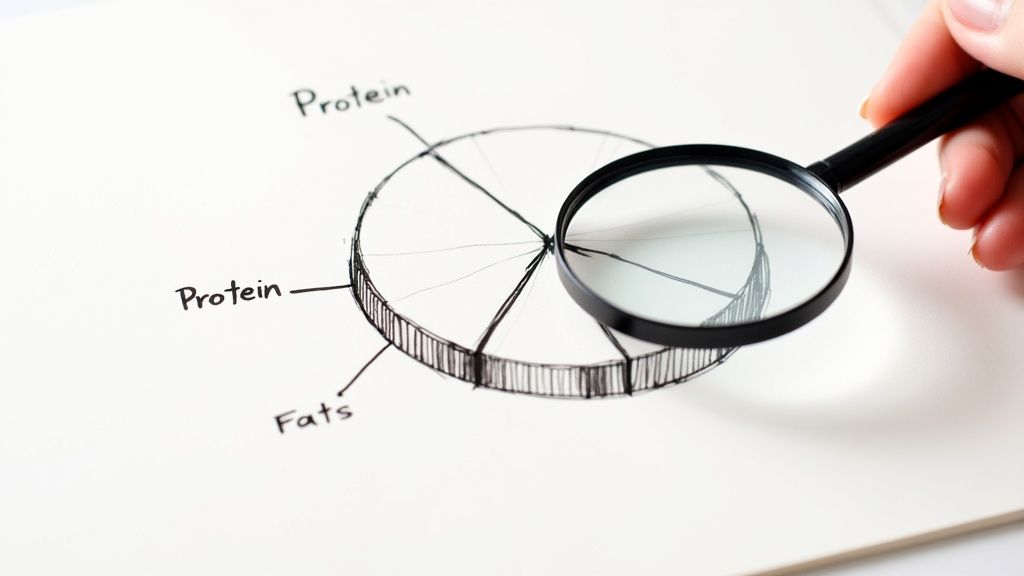
Think of your macro data less like a report card and more like a set of clues. It’s just information—neutral, non-judgmental feedback that helps you connect what you eat with how you feel. The goal isn’t to hit your targets with laser precision every single day. It’s really about building awareness and noticing the bigger picture.
From Data to Discovery
Instead of aiming for a flawless pie chart, try approaching your logs with a bit of friendly curiosity. You’re a detective looking for patterns, not a judge handing down a verdict on your eating habits.
As you look over your day or week, ask yourself some simple, open-ended questions:
- "Hmm, I was exhausted by 3 PM on Tuesday. What did I have for lunch that day?"
- "I see I'm consistently low on protein. Where could I sneak a little more in without much effort?"
- "My carb intake always seems to spike at night. Is that when I'm reaching for snacks while watching TV?"
Spotting these trends is where the magic happens. This is how you find the insights that lead to small, sustainable changes that actually stick.
Making Small, Sustainable Tweaks
Once you’ve uncovered a pattern, the key is to make a tiny adjustment, not a complete diet overhaul. Real, lasting habits are built on small, repeatable actions that feel almost too easy to fail.
For instance, if you realize your protein is always low on the days you skip breakfast, the answer isn't to start chugging a massive protein shake you hate. It might be as simple as boiling a few eggs to have on hand for the week or stirring a spoonful of Greek yogurt into your oatmeal.
The goal is to use your macro data as a gentle guide for mindful tweaks, not as a tool for self-criticism. It’s about asking, "What’s one small thing I can do tomorrow?"
Here are a few more examples of what this looks like in practice:
- Low on Protein? Toss a handful of chickpeas into your salad or have some edamame as an afternoon snack.
- Too Many Simple Carbs? Swap that daily soda for a flavored sparkling water or grab a piece of fruit instead of a cookie.
- Not Enough Healthy Fats? Sprinkle some chia seeds on your yogurt or add half an avocado to your toast.
Ultimately, using a macro calorie tracker is about empowerment, not restriction. When you look at your data with kindness and curiosity, you start learning what your body is truly asking for. It allows you to make smart, small choices that add up to big results, all without the pressure of being perfect.
Your Questions About Macro Tracking Answered
Jumping into the world of macro tracking can bring up a few questions. That’s completely normal. Let’s tackle some of the most common concerns that pop up when people first start out.
What If a Food Isn't in the Database or Seems Wrong?
So, you log a meal from your favorite local cafe, and the app spits out a number that just seems...off. Don’t panic! No food database is perfect, and honestly, it doesn’t need to be. The whole point of casual tracking is to build awareness, not to become a flawless food accountant.
When this happens, you have a couple of simple options:
- Find a close match: Search for a similar dish from a well-known chain restaurant. It won’t be exact, but it’s usually a pretty solid estimate.
- Break it down: If you can see the main ingredients—say, chicken, rice, and broccoli—just log them separately. A quick eyeball estimate is all you need.
- Just move on: Seriously. If a meal is a total mystery, it's fine to skip logging it once in a while. One unlogged meal won’t derail your progress. Consistency over the long haul is what truly matters.
Do I Have to Track Every Single Day?
Absolutely not. In fact, trying to be perfect every single day is one of the fastest ways to burn out. Life happens. There will be days when you’re too busy, too tired, or you just plain forget, and that’s okay.
Think of it this way: you’re trying to build a general picture of your eating habits, not create a perfect daily diary. Tracking just five or six days a week will give you more than enough data to see meaningful patterns. It’s the overall trend that gives you insight, not any single day's numbers.
Remember, this is about mindfulness, not a strict regimen. Giving yourself the flexibility to miss a day here and there is what makes the habit sustainable and stress-free.
How Do I Log My Food When I'm Eating Out?
Social events are a huge part of life, and your tracking goals shouldn’t stop you from enjoying a meal out with friends. This is another moment where smart estimation becomes your best friend. No one expects you to pull out a food scale at the dinner table!
Instead, lean into the "good enough" approach. Look for a similar item in your app's database from a popular restaurant. If you ordered a burger and fries, just find an entry for a standard burger and fries and call it a day. The key is to make a reasonable guess without letting it take over your evening.
This is where a tool like munchlog.ai really shines. Instead of fiddling with an app at the table, you can make a quick mental note and later just say, "I had a chicken Caesar salad and a glass of wine for dinner." The AI handles the estimation work for you, keeping the whole process discreet and effortless. This way, you can stay mindful while still living your life.
Ready to stop typing and start talking? Discover how effortless food tracking can be. Try munchlog.ai and log your next meal just by speaking. Get started at munchlog.ai today.