
Macronutrient Percentages for Muscle Gain: A Stress-Free Guide
macronutrient percentages for muscle gain: A clear, practical guide to balancing carbs, protein, and fats for steady muscle growth.
Posted by
 Munchlog
Related reading
Best Macros for Muscle Gain Made Simple
Discover the best macros for muscle gain without the stress. Our guide simplifies protein, carbs, and fats to help you build muscle effectively.
What's the Best Macronutrient Ratio for Muscle Gain?
Discover the ideal macronutrient ratio for muscle gain without the stress. Learn to track protein, carbs, and fats to fuel your fitness goals easily.
The Smart Eater's Guide to Macros for Muscle Gain (Without the Stress)
Discover the recommended macros for muscle gain to optimize your workouts. Learn proven tips for effective, stress-free muscle building.
So, what’s the magic formula for building muscle? A great starting point for most people is aiming for 30-35% protein, 40-55% carbohydrates, and 15-25% fat.
Think of these numbers less as a strict rule and more as a friendly guideline. It's a proven setup that fuels your workouts and helps with muscle growth, all without making nutrition feel like a second job.
Ditch Strict Diets for Smarter Macros
Feeling lost in a sea of complicated diet rules and confusing nutrition charts? You're not alone. Let's cut through the noise. This guide is for busy people who want to get stronger without turning their eating habits into a source of stress. We'll skip the heavy jargon and get straight to a mindful, flexible approach.
The numbers I mentioned above are a great baseline—a place to begin, not a rigid set of rules you have to hit perfectly every day. The real goal here is to understand how protein, carbs, and fats work together to help you build the body you want.
Awareness Trumps Perfection Every Time
Let’s be real: you’re not going to hit your macro targets perfectly every single day. And you shouldn't even try. The whole point is to build awareness of what you're eating, not to obsess over every last gram.
Building muscle is a long game. Consistency over weeks and months will always beat short-term perfection.
These macronutrients are a team, and each one has an important job:
- Protein is the non-negotiable building block for repairing and growing muscle.
- Carbohydrates are your body's main fuel source, giving you the energy to push hard in the gym.
- Fats are super important for hormone production (like testosterone) and your overall health.
The key is to see these macros as a team working together. When you give your body enough protein to rebuild, enough carbs for energy, and enough healthy fats to function well, you create the ideal environment for muscle growth.
Now, let's break down these starting points a bit more clearly.
A Simple Starting Point for Muscle Gain Macros
Use these flexible percentages as your starting point. Your ideal numbers will adapt to your body and lifestyle, but this is a great foundation.
| Macronutrient | Recommended Percentage Range | Its Role in Your Body |
|---|---|---|
| Protein | 30% – 35% | Rebuilds and repairs muscle tissue after training. |
| Carbohydrates | 40% – 55% | Provides the primary energy source for intense workouts. |
| Fats | 15% – 25% | Supports hormone production and overall cell function. |
This balance ensures you're covering all your bases for both performance and recovery.
And with a tool like Munchlog, tracking becomes as easy as sending a voice note. Instead of meticulously typing in every ingredient from your homemade chili, you can just say, "I had a bowl of chili with ground turkey and beans."
This approach helps you stay mindful of your nutrition while actually living your life. You can focus on progress, not perfection, making it so much easier to stick with your goals long enough to see real results.
Find Your Calorie and Protein Starting Point
Before we even talk percentages, we need a solid baseline. Let's figure out your daily calorie target for building muscle—and I promise, the math is simple. To build muscle effectively, you need to be in a slight calorie surplus, which just means eating a bit more than your body burns each day.
We're going to skip the complicated formulas and get you a reliable estimate quickly. More importantly, we'll zero in on protein, which is hands-down the most critical macro for muscle repair and growth.
First Things First: Your Calorie Target
A super straightforward way to estimate your starting calories is to multiply your current body weight (in pounds) by a number between 15 and 17.
- Less active outside the gym? Use your body weight x 15.
- Pretty active and training hard? Go with body weight x 17.
So, for a 180-pound person who hits the gym consistently, a great starting point would be around 3,060 calories per day (180 x 17). This isn't an exact science, but it’s a fantastic, stress-free estimate to get the ball rolling.
Protein Is Your Priority
Now for the non-negotiable part: protein. Forget vague percentages for a moment. It's much easier and more effective to aim for a specific number of grams each day. This makes tracking feel more tangible and less like a constant math quiz.
A well-established and highly effective target for muscle gain is 0.8 to 1 gram of protein per pound of your body weight.
That same 180-pound person? They should be aiming for 144 to 180 grams of protein every single day. Hitting this target consistently is what truly moves the needle. If you want to get more granular on this, check out our guide on how to calculate daily protein needs.
Setting a clear protein goal in grams simplifies everything. It becomes your daily non-negotiable, while carbs and fats offer more flexibility based on your energy levels and personal food preferences.
This process flow shows you exactly how to think about it: protein first, then everything else.
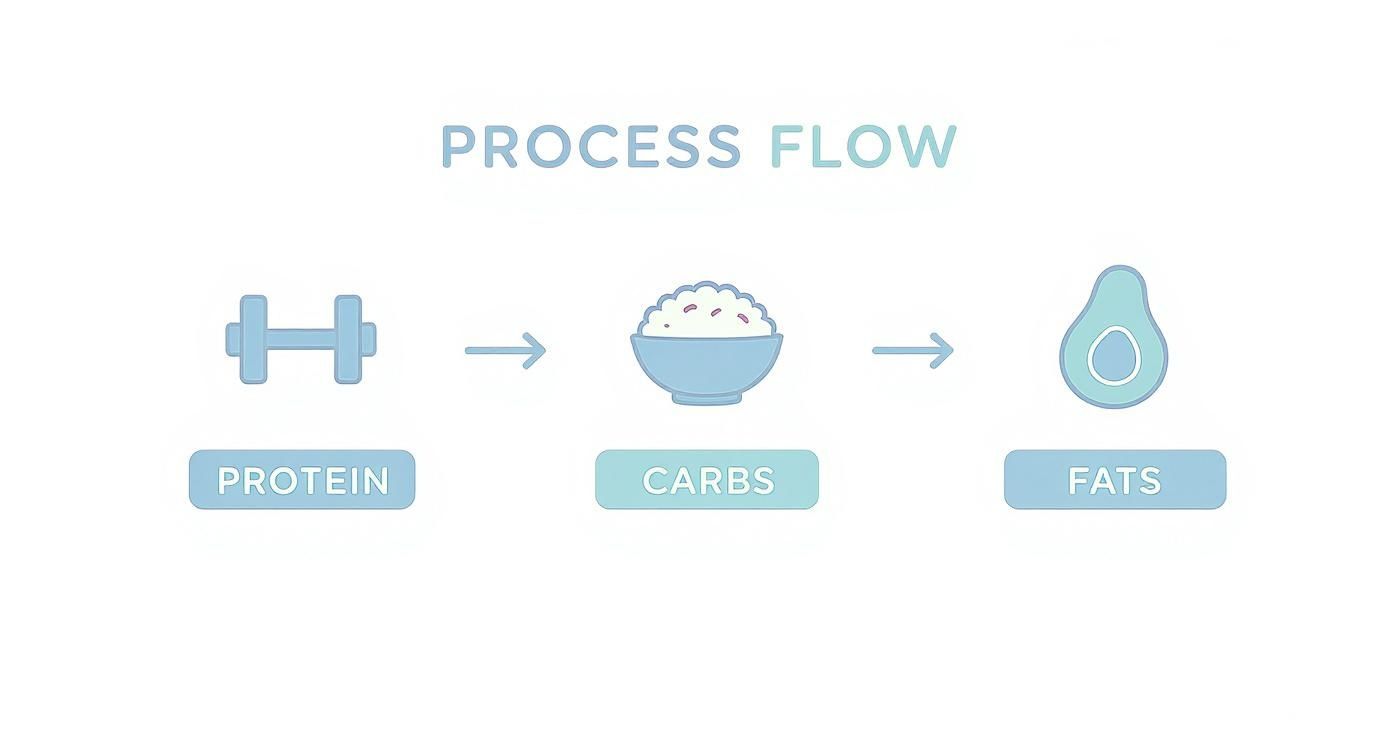
As you can see, you lock in your protein target first, then you fill in the rest of your calories with carbs for energy and fats for health. Science backs this up, too. Research shows that people who lift weights can direct more of those extra calories toward building muscle (instead of storing fat) when they eat a higher-protein diet.
A solid macro split that aligns perfectly with this protein-first strategy usually lands somewhere around 25-35% protein, 45-55% carbs, and 15-25% fat.
Splitting Carbs and Fats Without the Stress
Alright, you’ve locked in your protein goal. That’s the big one, so give yourself a pat on the back. The rest of this process—dividing up your remaining calories between carbs and fats—is where you get to play around and find what works for you.
Think of it like this: carbohydrates are your high-octane workout fuel, while fats are essential for keeping your hormones in check and your body running smoothly. You need both, but the exact ratio isn't a life-or-death decision. It’s more about finding a groove that fits your energy, your workouts, and the foods you actually like to eat.
Listen to Your Body, Not a Strict Rulebook
There’s no magic macronutrient percentage for carbs and fats that works for everyone. The best split is deeply personal.
So, ask yourself: do you feel like a beast in the gym after a meal with rice or potatoes? Or do you feel more clear-headed and satisfied with higher-fat foods like avocados, nuts, and olive oil? Your answer to that simple question is your best starting point.
A student pulling late-nighters might feel way better with more carbs for brain fuel. On the other hand, a busy professional who needs to stay sharp through meetings might prefer more fats to feel full and avoid a carb-induced crash. The whole point is to build a plan you can live with.
The best split between carbs and fats is the one you can stick with consistently because it matches your energy needs and the foods you genuinely enjoy eating. Personal preference is a powerful tool for long-term success.
Finding Your Ideal Carb and Fat Balance
For most people, a split of 40-50% carbohydrate and 20-30% fat from total daily calories is a fantastic, balanced starting point. This gives you plenty of fuel for your training sessions without skimping on the healthy fats your body needs for hormone production.
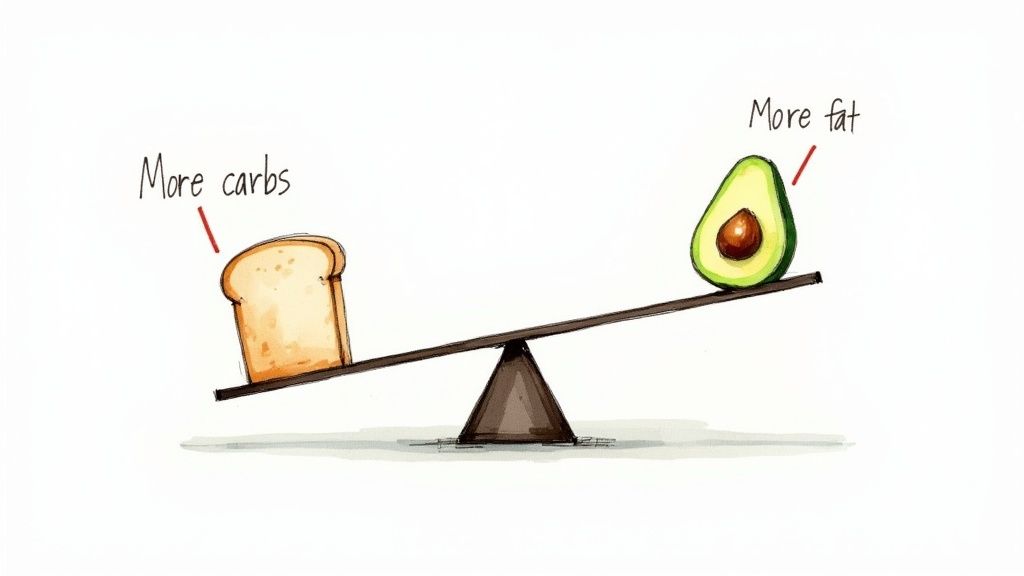
Let’s go back to our 180-pound person who’s eating 3,060 calories and 180g of protein. Here’s how the math shakes out:
- Protein is set: 180g (which is 720 calories).
- Remaining Calories: 3,060 - 720 = 2,340 calories to play with for carbs and fats.
Now, we can split those remaining 2,340 calories in a couple of common ways:
- More Carbs for Higher Energy (50% Carbs / 20% Fat): This setup is perfect if you train hard or have a physically demanding job. It prioritizes keeping your muscle glycogen stores topped off.
- A More Balanced Approach (40% Carbs / 30% Fat): This is a great middle-of-the-road option that supports both energy and hormonal health. It’s a versatile and solid choice for most people just starting.
Ultimately, the numbers are just a guide. The real answer comes from trying things out and seeing how you feel.
If you want to skip the manual math, you can always use a tool to get a personalized starting point. Our handy protein, carb, and fat ratio calculator can do the heavy lifting for you.
The great thing about casual tracking with an app like Munchlog is you don’t have to get obsessive. Just log your meals by voice—"I had chicken breast with a sweet potato and some avocado"—and you’ll get a general feel for where you’re at. Over time, you'll naturally start to notice which meals make you feel and perform your best.
Real-World Examples of Muscle-Building Macros
Theory is one thing, but seeing how macronutrient percentages for muscle gain play out in a real kitchen is what truly makes it click. Let's move past the numbers and look at what this actually looks like for different people with different lives. After all, your nutrition plan needs to fit your schedule, not the other way around.

To show you just how flexible and achievable this can be, we'll break down what a typical day might look like for three very different people.
The Busy Professional
Meet Alex, a 28-year-old software developer who weighs 185 pounds. He trains three to four times a week after work but spends most of his day at a desk. His focus is on convenience and high-protein meals that keep him full during long meetings.
- Estimated Daily Calories: ~2,960 (185 lbs x 16)
- Protein Goal: 185g (1g per lb of body weight)
- Carbs Goal: 325g
- Fat Goal: 105g
A day of eating for Alex might look like grabbing a protein shake on the way out the door, having a pre-prepped chicken and quinoa bowl for lunch, and then a hearty salmon dinner. Snacking on Greek yogurt and nuts helps him easily hit his protein target without much fuss.
The Parent Juggling It All
Next up is Sarah, a 42-year-old parent of two who weighs 150 pounds. She squeezes in early morning workouts before the kids wake up and needs energy that lasts all day. For her, the priority is simple, family-friendly meals she can track without adding more stress to her day.
- Estimated Daily Calories: ~2,400 (150 lbs x 16)
- Protein Goal: 135g (0.9g per lb of body weight)
- Carbs Goal: 265g
- Fat Goal: 87g
Sarah’s day often starts with scrambled eggs and toast. Lunch might be leftovers from the previous night's dinner—like turkey chili—and a snack could be a simple apple with peanut butter. For anyone this busy, meal prep is a lifesaver. Planning ahead with things like easy vegan meal prep ideas can make hitting those targets a whole lot easier.
The goal isn't to eat perfectly, but to make conscious choices that align with your goals most of the time. Sarah doesn't stress if she has a slice of pizza with her kids; she just logs it casually and knows her weekly average is what matters.
The College Student on a Budget
Finally, there’s Maria, a 21-year-old student who weighs 130 pounds. She walks everywhere on campus and lifts weights in the university gym. Her biggest challenge is hitting her protein goal without breaking the bank.
- Estimated Daily Calories: ~2,210 (130 lbs x 17)
- Protein Goal: 130g (1g per lb of body weight)
- Carbs Goal: 245g
- Fat Goal: 77g
Maria relies on budget-friendly protein sources to make it work. A typical day might include oatmeal with a scoop of protein powder for breakfast, a big batch of rice and beans with ground turkey for lunch and dinner, and cottage cheese as a late-night snack.
It's clear from these examples that one size definitely does not fit all. To give you an even better idea, here's a table showing how these numbers can shift based on different factors.
Sample Daily Macro Targets for Different Lifestyles
See how calorie and macro goals can be adjusted based on individual factors like age, weight, and activity level. These are just examples to guide you.
| Profile | Daily Calories | Protein (g) | Carbs (g) | Fat (g) |
|---|---|---|---|---|
| 28-Year-Old Male, 185 lbs, Active | ~2,960 | 185 | 325 | 105 |
| 42-Year-Old Female, 150 lbs, Active | ~2,400 | 135 | 265 | 87 |
| 21-Year-Old Female, 130 lbs, Very Active | ~2,210 | 130 | 245 | 77 |
| 35-Year-Old Male, 200 lbs, Moderately Active | ~3,000 | 200 | 325 | 100 |
As you can see, the "right" numbers really depend on who you are and how you live. The key is to find a starting point and adjust from there.
These examples show that no matter your lifestyle, you can find a way to make your macros work for you. Using a voice-logging tool like Munchlog makes it even easier—just say, "I had two eggs with toast," and keep moving with your day.
Track Your Macros Without the Headache: The Voice Logging Method
Alright, you've got your target numbers. Now comes the part where most people throw in the towel: actually tracking what you eat. How do you keep an eye on your intake without adding another tedious chore to your already packed day?
Let's be honest, traditional food logging apps often fail us here. The old way of doing things—meticulously weighing every gram of chicken and scrolling through endless databases—is the fastest way to burn out. It turns eating, which should be enjoyable, into a stressful data-entry job.
I've seen it time and time again. People get excited, track for a week, then life gets in the way. There’s a better way, and it’s what I call "casual tracking." It’s about being mindful, not militant. This is exactly where an app like Munchlog completely changes the game.
Just Say What You Ate
Instead of fumbling with your phone to log every ingredient in your salad, imagine just saying it out loud. For instance, you could simply say, "I had a coffee with a splash of milk and a banana for breakfast." That’s it.
This voice-first approach removes all the usual friction. No more searching for "banana, medium" or trying to guesstimate how many ounces of milk you poured. The whole point is to make tracking your food feel as natural as talking.
The goal isn’t to nail your macronutrient percentages for muscle gain perfectly every single day. The real win is building awareness. When tracking is this easy, you actually stick with it long enough to see what's working and what isn't.
You start to build a mental picture of your eating patterns without the stress, which naturally leads to smarter, more intuitive decisions throughout your day.
Turning Awareness Into Action
Casual tracking isn't about getting a perfect score. It's about getting useful feedback you can act on. It’s about making small, in-the-moment adjustments that really add up over time.
This new mindset looks a lot more like this:
- Notice your protein is a bit low by mid-afternoon? No big deal. You just know to grab a Greek yogurt or a protein bar for your next snack.
- Feeling sluggish before your workout? A quick glance at your log might show you’ve been light on carbs. Easy fix—add a piece of fruit.
- Realize your day has been mostly carbs and protein? You’ll consciously add some healthy fats, like avocado or a handful of almonds, to your dinner.
It’s about using a simple tool to support your muscle-building goals, not letting a tool run your life. This method of keeping a simple food diary app makes nutrition feel less like a restrictive diet and more like a sustainable habit. You’re just gathering information to help you feel and perform your best.
Fine-Tuning Your Macros As You Progress
Your body is an incredibly adaptive machine. As you get stronger, your nutritional needs will inevitably shift. The macros that got you great results in your first month might not be what you need six months down the road. The trick is to treat your macro targets not as set-in-stone rules, but as a flexible blueprint that evolves with you.
Making adjustments doesn’t mean you have to tear up your entire plan and start over. It's more about making small, intelligent tweaks based on the feedback you're getting. Think of yourself as the captain of the ship, using your tracking data as your compass, not a final grade.
Learn to Read Your Body’s Cues
The best indicators for when it's time to adjust come directly from your performance in the gym and how you feel every day. Your body is constantly sending signals—you just have to learn how to interpret them.
Here are a few tell-tale signs that it might be time for a small adjustment:
- Workouts feel like a slog. If you're feeling sluggish or weak during your lifts, that's often the first clue you're under-fueled. A small bump in your daily carbs can work wonders for your energy.
- Your progress has hit a wall. Has the scale been stuck for a few weeks? Are your lifts no longer increasing? A slight increase in total calories, mostly from protein and carbs, can often provide the spark needed to get things moving again.
- You feel constantly sore and run-down. Some muscle soreness is a good thing, but if you're always feeling beat up, your body might be begging for more resources to repair itself. This is where both protein and overall calories play a massive role.
As you navigate these adjustments, remember that recovery is just as important as the work you do in the gym. Integrating effective strategies to improve muscle recovery will complement your nutrition plan and help you make consistent gains.
Making Smart, Gradual Adjustments
When you decide it's time for a change, the name of the game is strategy and patience. Resist the urge to make drastic moves like adding or cutting hundreds of calories overnight.
Your body responds best to gradual changes. A small, calculated adjustment of 100-200 calories per day is often all it takes to break through a plateau without adding unnecessary body fat. Start there, hold steady for a couple of weeks, and observe the results.
Interestingly, for those of us focused on building lean mass, the upper limit for protein might be higher than commonly believed. One study on resistance-trained athletes found that even a very high-protein diet didn't lead to increased fat gain, highlighting how well the body can use extra protein during a surplus. If you want to dive deeper, you can read more about these protein findings.
The easiest way to implement these small changes is with a tool that doesn't add more friction to your day. With Munchlog, you can just say, "I had a large sweet potato instead of a medium one," and see how that simple tweak impacts your energy and progress. It’s all about making this process sustainable for the long haul.
Clearing Up Common Macro Tracking Questions
Starting anything new, especially when it comes to nutrition, naturally brings up a few questions. When you first dive into tracking macros, a few common concerns tend to pop up again and again. Let's tackle them head-on so you can start with confidence and leave the stress behind.
Do I Really Need to Hit My Macros Perfectly Every Single Day?
Let’s get this out of the way right now: absolutely not. In fact, chasing perfection is probably the fastest way to get frustrated and quit. The real magic happens with long-term consistency, not by nailing your exact gram targets day in and day out.
Think of your macronutrient percentages for muscle gain more like a weekly average. Some days you might go higher on carbs to fuel a big workout, and other days might naturally be higher in fats. That's just life. The whole point of casual tracking is to stay in the right ballpark, not to obsess over every last gram.
How in the World Do I Track Macros When I Eat Out?
This is where the old, tedious way of tracking completely falls apart and why casual voice logging is such a lifesaver. You don't need the restaurant's certified nutritional breakdown to stay on track.
You just say, "I had a burger and a side salad for lunch," into an app like Munchlog. It gives you a solid estimate, and honestly, that's all you need. Focus on making a smart choice when you can—like making sure your meal has a solid protein source—and just log what you ate. A good estimate is infinitely better than giving up and tracking nothing at all.
Building muscle is a marathon, not a sprint. Be patient, focus on how you feel and perform in the gym, and trust that consistent effort is what truly drives results.
How Soon Will I Actually See Results?
Patience is your best friend here. If you're training consistently and hitting your calorie and protein goals most of the time, you could start feeling stronger and seeing real performance boosts in the gym within 4 to 8 weeks.
Visible changes in the mirror, of course, take a bit longer. Instead of obsessing over your reflection, pay attention to the non-scale victories. Are you lifting heavier? Do you have more energy? Are you less sore after workouts? Those are the real signs you're on the right path. Trust the process, and the physical results will follow.
Ready to track your macros without all the tedious typing? Get started with munchlog.ai and see how easy it is to stay mindful of your nutrition using just your voice. Find out more at https://munchlog.ai.