
Your Guide to Mixed Nuts Nutrition Information
Unlock the mixed nuts nutrition information you need. Learn how calories, fats, and protein in your favorite snack add up and how to track them easily.
Posted by
 Munchlog
Related reading
Calories in Purple Onions and How to Track Them Stress-Free
Discover the calories in purple onion (raw vs cooked) and learn simple, stress-free ways to track them for a balanced diet. Your guide to mindful eating.
The Real Scoop on Calories in Air Fried Chicken Breast
Discover the true calories in air fried chicken breast and learn how simple recipe changes affect your macros. Find out how easy it is to track your meals.
How Many Calories in Bread and Butter? (It's More Than You Think)
Curious about calories in bread butter? This clear guide breaks down the numbers for different bread types and shows you how to track snacks with ease.
Mixed nuts are one of those snacks that feel like a treat but are actually pretty good for you. But what's really going on, nutritionally speaking? For a standard 28-gram (1-ounce) serving—think a small handful—you're looking at roughly 160 to 200 calories. That little handful is loaded with healthy fats, protein, and fiber, making it a seriously smart choice that keeps you feeling full way longer than a sugary alternative would.
What Is in a Handful of Mixed Nuts
Let's get into the specifics of what that handful really offers. It's more than just a crunchy, convenient snack; it’s a tiny powerhouse of energy and essential nutrients. But what does that actually mean for your body and your day?
Mixed nuts are a fantastic source of macronutrients—the big three: protein, fat, and carbohydrates that fuel your body. The specific balance is what makes them so incredibly satisfying. You get a solid dose of plant-based protein for muscle support, and plenty of healthy fats that are crucial for brain health and feeling full. If you want a quick refresher on the basics, check out our simple guide on what macronutrients are and see some examples.
A Quick Nutrition Snapshot
So, let's look at the numbers for that typical 28-gram serving.
Here’s a quick look at the average macros you'll find in a standard handful of plain, unsalted mixed nuts.
Typical Nutrition in a Handful of Mixed Nuts (Approx. 1 oz / 28g)
| Nutrient | Average Amount | What This Means For You |
|---|---|---|
| Calories | 160–200 | Provides sustained energy without the sugar crash. |
| Protein | 5–6 grams | Helps with muscle repair and keeps you feeling satisfied. |
| Fat | 13–18 grams | Primarily heart-healthy unsaturated fats for brain function. |
| Fiber | 2–3 grams | Supports digestion and helps control blood sugar levels. |
The key takeaway here is the combination. The protein, fat, and fiber work together to provide steady, long-lasting energy. For a deeper dive into the different types of dietary fats and why they're important, a great resource is understanding the nutritional value of fats.
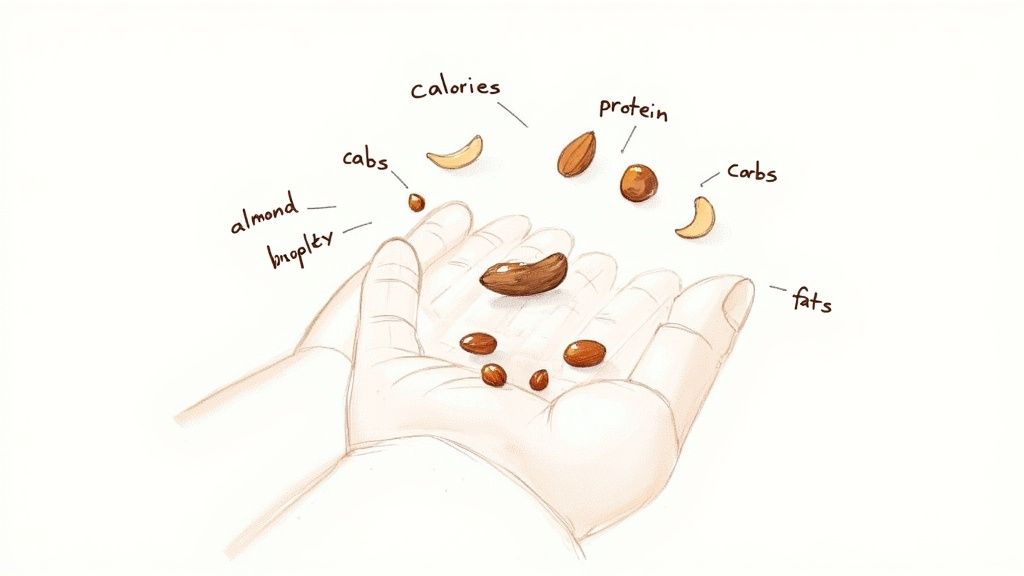
This balanced profile makes nuts the perfect snack to beat that dreaded afternoon slump. Instead of a quick sugar rush followed by an energy crash, you get a much more stable and sustained release of energy.
And here’s the best part: you don't need to get bogged down by the numbers. Just saying, "I had a handful of mixed nuts" into Munchlog is all it takes. Our AI handles the estimation for you, so you can stay mindful of your intake without the stress of measuring every single nut.
Why Mixed Nuts Became Everyone's Favorite Healthy Snack
Let's be honest, mixed nuts are everywhere. And for good reason. They’ve become the ultimate grab-and-go snack because they perfectly match our hectic lives, where we want food that’s both simple and actually good for us. A bag in the car, a jar on the desk, a pouch in a backpack—they’re just easy.
But the real win is how they make you feel. Think about that afternoon slump. Instead of reaching for a sugary fix that leads to an inevitable crash, mixed nuts provide a steady, reliable source of energy. Their powerhouse combo of protein, healthy fats, and fiber keeps you feeling full and focused, making them a smart choice when you need to power through the day. That's exactly why understanding mixed nuts nutrition information is so valuable.
We're All Snacking Smarter Now
There's been a huge shift in how people think about food. We're moving away from empty calories and looking for whole-food options that not only satisfy hunger but also contribute to our overall health. This isn't about dieting; it's about being more intentional with our choices.
Swapping a candy bar for a handful of nuts is a perfect example of this small, powerful change in action.
The market backs this up, too. The global demand for mixed nuts is skyrocketing, with the industry valued at around $13.5 billion in 2023 and showing no signs of slowing down. This surge is driven by a collective desire for healthier, nutrient-packed snacks that fit our busy schedules. If you're curious about the numbers, you can dive into the full market report for a deeper look.
Choosing mixed nuts isn't about strict dietary rules. It's a mindful swap—giving your body steady energy from a real, whole-food source to help you feel better and stay sharp.
This desire for better snacking fits perfectly with the idea of casual nutrition tracking. You don't have to weigh and measure every single thing to make progress. Simply understanding the basics helps you make better decisions in the moment.
Logging your snack with a quick voice command like, "I had a handful of mixed nuts," is a great way to stay aware without adding stress. It’s about being mindful, not militant—and that’s how you build healthy habits that actually last.
What's Really in Your Handful of Mixed Nuts?
No two bags of mixed nuts are created equal. Grab one, and it might be loaded with almonds; grab another, and walnuts could be the star. While that variety is fantastic for your taste buds, it also means the mixed nuts nutrition information can shift quite a bit from one handful to the next.
Think of it like a team of nutritional specialists. Each nut brings something unique to the table. Once you know what each one offers, you can find a mix that lines up with your specific goals—whether that's packing in more protein, getting certain healthy fats, or just boosting your vitamin and mineral intake.
Meet the Nutritional Power Players
Let's take a closer look at some of the common nuts you'll find jumbled together in your favorite snack mix. Each one has its own distinct nutritional strengths.
- Almonds: Often the foundation of a good mix, almonds are packed with vitamin E, a powerful antioxidant that helps protect your cells from damage. They also serve up a healthy dose of magnesium, which is crucial for everything from energy production to muscle function.
- Walnuts: You can't miss their unique, brain-like shape, and funnily enough, they're famous for their high concentration of omega-3 fatty acids (the plant-based kind, known as ALA). These are the good fats that are consistently linked to supporting brain health.
- Cashews: These creamy, crescent-shaped nuts are a great source of minerals, especially magnesium and copper. Your body needs magnesium for nerve function and energy, while copper is essential for forming red blood cells.
This is precisely why mixed nuts are such a powerhouse snack. You're not just getting the benefits of one type of nut; you're getting a broad spectrum of nutrients all in one go.
Why the Ratio of Nuts Makes a Difference
The exact blend in your bag truly matters. A mix that's 50% peanuts is going to have a very different fat and protein breakdown than one that's 50% almonds and walnuts. This isn't just about your personal snack bag, either—it's reflected in global consumption patterns.
For example, almonds are eaten in massive quantities around the world, making their vitamin E and magnesium contributions widespread. On the other hand, you have Brazil nuts, which are absolute selenium bombs (a mineral critical for antioxidant defense), but they're consumed in smaller amounts. The United States alone consumes 6,390 metric tons of them. You can dive deeper into these trends by exploring more nut consumption statistics.
The beauty of mixed nuts lies in their diversity. Every handful delivers a slightly different combination of vitamins, minerals, and healthy fats, turning a simple snack into a surprisingly dynamic source of nutrition.
Getting familiar with the main players helps you make smarter choices at the grocery store. More importantly, it helps you understand the why behind the nutrition without needing a science degree.
And when it's time to log your snack, don't get hung up on the exact ratio. Just tell Munchlog, "I had a handful of mixed nuts with almonds and walnuts," and our AI will crunch the numbers for a smart estimate. The goal is to be mindful, not to be a food scientist. This keeps things simple so you can focus on enjoying your delicious, nutrient-packed snack.
How Salt, Sugar, and Oil Change the Game
Grabbing a container of mixed nuts feels like a straightforward, healthy choice. But the way they're prepared can completely rewrite their nutritional story. Think of raw nuts as the clean, simple baseline—what you see is what you get.
Once salt, sugar, and oil come into play, the numbers on that nutrition label can shift dramatically.
It often starts with the cooking method. Dry-roasted nuts are cooked with just hot air, so their calorie and fat content stays nearly identical to raw nuts. On the other hand, oil-roasted nuts are cooked in, you guessed it, oil. They inevitably soak up some of that extra fat, which nudges their total calorie count a little higher. It’s a small detail, but one worth noting when you're at the grocery store.
The nuts themselves are nutritional powerhouses, each bringing something unique to the mix.
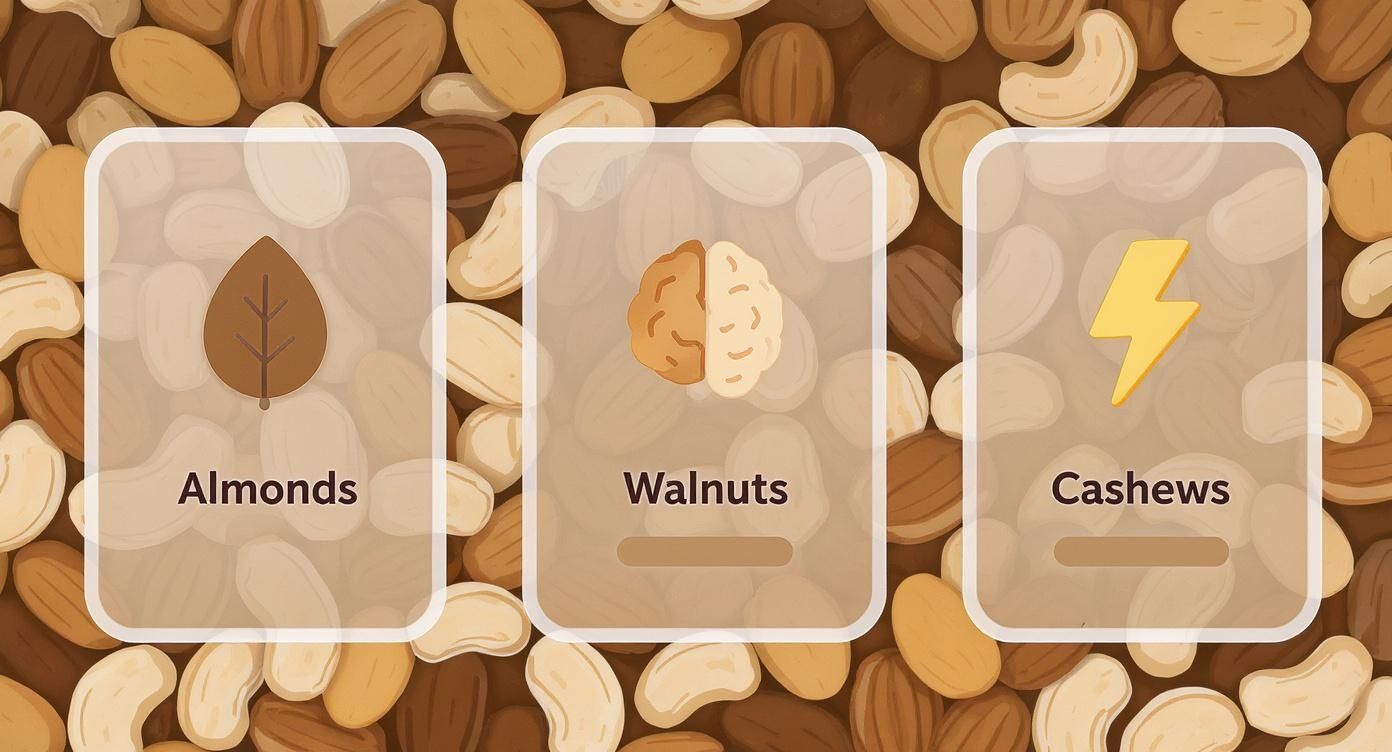
From the vitamin E in almonds to the omega-3s in walnuts, you're getting a fantastic range of micronutrients in every handful.
When a Snack Becomes a Dessert
The real game-changer, though, is the coatings. That savory, can't-stop-eating flavor often comes with a hefty dose of sodium. Just one 1/4 cup serving of some commercially salted nut mixes can pack over 200 mg of sodium—that's already pushing 10% of the recommended daily limit.
This is a classic case where knowing how to read nutrition labels effectively is your best tool. It helps you see past the health hype and understand exactly what you're eating.
Then you have the sweet stuff. Honey-roasted, chocolate-drizzled, or yogurt-covered nuts are undeniably delicious, but they blur the line between a nutrient-dense snack and a straight-up dessert. A handful of candied pecans, for example, can easily carry an extra 10-15 grams of sugar compared to their plain counterparts.
Here's a quick look at how these preparations stack up against each other.
Raw vs. Roasted vs. Candied Nuts: A Quick Comparison
See how preparation methods change the nutritional profile of a standard 1/4 cup serving of nuts.
| Nut Type | Calories (Approx.) | Added Sodium | Added Sugar |
|---|---|---|---|
| Raw Almonds | 205 | 0 mg | 0 g |
| Oil-Roasted, Salted Almonds | 215 | 100-200 mg | 0 g |
| Honey-Roasted Almonds | 220 | 50-100 mg | 10-15 g |
As you can see, the calories creep up, but the added sodium and sugar are where you see the biggest jump.
The nut at the core is still good for you. It's the coatings you need to watch. Think of them like accessories—a little can be fine, but too much can easily overwhelm the whole outfit.
When you're logging these snacks, being specific makes all the difference. Instead of just telling your tracker "mixed nuts," try saying something like, "I had a handful of honey-roasted mixed nuts." This simple detail gives Munchlog the context it needs to deliver a much more accurate estimate, keeping you informed without any extra hassle.
Track Mixed Nuts Without a Measuring Cup
Let’s be real—you probably aren’t carrying a food scale or a set of measuring cups with you to work. When you're at your desk or out on a hike and grab a handful of mixed nuts, stressing about perfect measurements is the last thing on your mind. This is where casual tracking really shines. It’s all about mindful estimates, not perfect precision.
The goal isn't to be flawless; it's to be aware. Just because you've ditched the tools doesn't mean you can't get useful mixed nuts nutrition information into your log. Instead, you can rely on simple visual cues that are always with you—literally.
For a deeper dive into when exact measurements matter most, our article on how to weigh food for weight loss is a great resource. But for your day-to-day snacking? Estimation is king.

Use Your Hand as a Guide
Your own hand is an incredibly convenient and surprisingly accurate portioning tool. You can use it to estimate serving sizes quickly and discreetly, no matter where you are.
Here are a few easy visual guides to keep in your back pocket:
- A Small, Cupped Handful: This is your go-to for a standard one-ounce serving (about 1/4 cup). It’s the portion size you'll see on most nutrition labels and usually lands in the ballpark of 160-200 calories.
- Your Thumb: The tip of your thumb, from the top knuckle up, is a great stand-in for about one tablespoon. Perfect for estimating a small sprinkle of nuts over your morning yogurt or a salad.
- A Level Palm: A single, flat layer of nuts covering your palm (not mounded up!) is another solid way to eyeball a single serving.
These simple reference points empower you to make a smart guess without getting bogged down by details. It’s all about building a better sense of portion sizes that you can apply to any situation.
The point of casual tracking isn't to hit a specific number on a scale. It's to build an intuitive understanding of your portions, making mindfulness a natural part of your routine.
Let AI Do the Heavy Lifting for You
This is exactly where voice logging becomes a game-changer. You don’t have to do the mental gymnastics of translating your real-world estimate into grams or ounces. Munchlog is built to understand how people actually talk about food.
Instead of trying to calculate the macros yourself, you just speak your reality.
Simply say, "I had a small handful of mixed nuts this afternoon." Our AI takes that casual phrase and converts it into a smart nutritional estimate based on typical values. It knows the difference between "a sprinkle" and "a large handful," giving you credit for your snack without demanding impossible precision. This makes tracking feel less like a chore and more like a quick, helpful check-in with yourself.
Your Mindful Snacking Plan
Alright, you've got the nutritional lowdown on mixed nuts. Now, let's talk about how to actually use this knowledge in the real world. This isn't about setting up a bunch of rigid rules or banning snacks you love. It's about developing a smarter, more mindful way of eating that actually fits into your life.
The whole point is to be aware, not obsessive. You can absolutely keep enjoying your favorite handful of nuts while also understanding how they're fueling your body.
Simple Steps for Smarter Snacking
Turning this into a habit really just comes down to a few practical tips. Think of these as helpful guidelines, not strict orders.
- Choose Wisely: When you have the choice, grab the nut mixes with the least amount of added salt, sugar, and oil. Raw or dry-roasted nuts are your best bet for pure nutrition.
- Embrace Estimation: Get comfortable using simple visual cues to gauge your portions. A small handful is an excellent, nutrient-packed snack that delivers steady energy without going overboard.
- Ditch Perfection: Don't get hung up on the exact ratio of almonds to cashews in every scoop. A solid estimate is always, always better than skipping logging altogether.
This balanced mindset is exactly what we're all about at Munchlog. We genuinely believe that enjoying your food is a non-negotiable part of a healthy lifestyle. It all comes down to awareness, not restriction. To see how this applies to your bigger picture, check out our guide on how to track macros without all the stress.
The goal isn’t to track every calorie perfectly. It’s to build a gentle awareness that empowers you to make choices that feel good, one handful of nuts at a time.
With a tool like Munchlog, you can just say, "I had a handful of mixed nuts," and know you're staying on track. It's the simplest way to find that sweet spot between enjoying your food and crushing your wellness goals.
Common Questions About Mixed Nuts
Once you start tracking your food, you naturally start asking more questions. That's a good thing! Here are a few common queries we get about mixed nuts and how to handle them without any stress.
Are Salted Mixed Nuts Unhealthy?
Not necessarily, but you do have to be a little more aware of what you're eating. The nuts themselves are still full of great nutrients, but the added salt can really push up your daily sodium intake if you're not careful. If you're keeping an eye on your sodium, grabbing an unsalted or lightly salted version is probably your best bet.
A simple voice log like, "a handful of salted mixed nuts" in Munchlog makes it easy to keep track. It's all about being mindful, not about restricting yourself.
What’s a Good Portion Size for Mixed Nuts?
A good rule of thumb is about 1/4 cup, which is roughly a small handful that fits neatly in your palm (around 1 ounce or 28 grams). That portion size usually lands you in the 160-200 calorie range and delivers a great mix of healthy fats, protein, and fiber.
Because they’re so easy to snack on mindlessly, using your hand as a quick measuring tool is a fantastic way to keep portions in check without having to pull out the measuring cups.
The best portioning tool is the one you always have with you. Your hand is a simple, effective guide for estimating a satisfying snack size without the need for a measuring cup.
How Do I Log Mixed Nuts Without Knowing the Exact Ratio?
This is where a more relaxed approach to tracking really shines. You don't need to break down the exact number of almonds versus cashews to get a good estimate. Just tell your tracking app, "I had a bowl of mixed nuts."
AI-powered trackers like Munchlog are smart enough to use a standard nutritional profile for "mixed nuts," which gives you a very solid average. It’s always better to log a good estimate than to skip it because you're worried about getting it perfectly right.
Are Roasted Nuts Less Healthy Than Raw Nuts?
The nutritional difference is actually pretty minimal. Dry-roasted nuts, which are cooked without any oil, are nearly identical to their raw cousins in terms of calories and macros. If they're roasted in oil, they'll have slightly more fat and a few extra calories, but it's usually not a huge jump.
The biggest changes to a nut's nutritional profile come from what's added after roasting—things like heavy salt, sugary glazes, or chocolate coatings. For the most part, you can feel great about choosing either raw or dry-roasted nuts.
Ready to stop guessing and start tracking your food the easy way? With munchlog.ai, you can log your meals and snacks just by talking. No typing, no photos, just your voice. Get started and see how simple mindful eating can be.