
What Is a Calorie Deficit? A Stress-Free Guide to How It Works
what is calorie deficit diet: discover how it works, how to calculate your deficit, and tips to start without stress.
Posted by
 Munchlog
Related reading
The Real Scoop on Calories in Air Fried Chicken Breast
Discover the true calories in air fried chicken breast and learn how simple recipe changes affect your macros. Find out how easy it is to track your meals.
How Many Calories in Bread and Butter? (It's More Than You Think)
Curious about calories in bread butter? This clear guide breaks down the numbers for different bread types and shows you how to track snacks with ease.
How to Count Calories Without the Stress
Learn how to count calories easily with practical, mindful tracking tips for sustainable progress toward your goals.
Ever heard the term "calorie deficit" and pictured sad salads and endless hunger? Let's clear the air. At its core, a calorie deficit is surprisingly simple: it just means you're eating fewer calories than your body uses for energy each day.
Think of it like a friendly energy budget. When you consistently "spend" more energy than you "deposit" through food, your body dips into its savings—which, in this case, is stored body fat. This simple idea is the real engine behind any effective weight loss plan, no extreme measures needed.
Your Body Is an Energy Budget
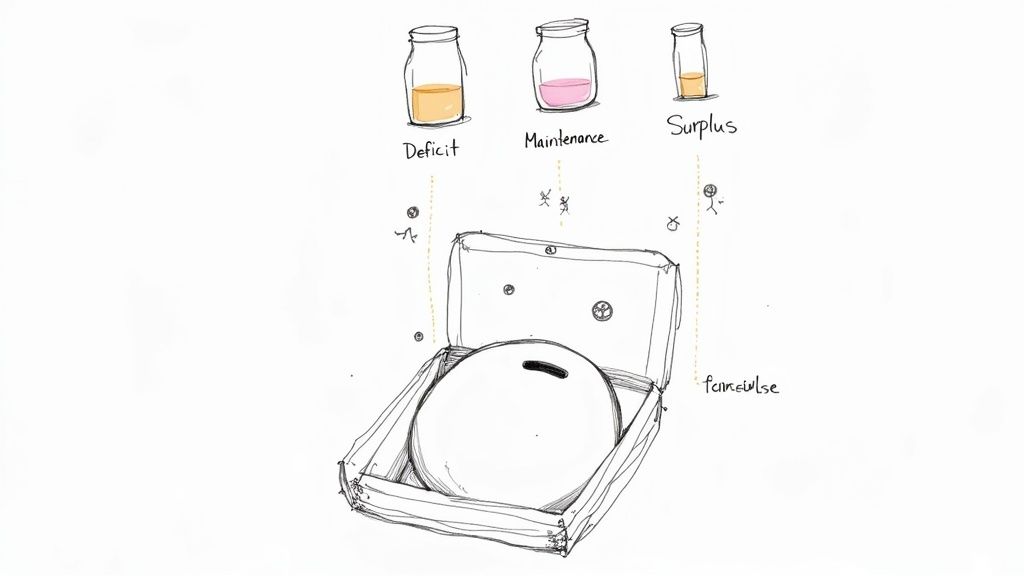
Let’s strip away the jargon. Imagine the calories you eat and drink are your daily income. The energy your body uses for everything—breathing, thinking, walking to grab a coffee—are your expenses.
Depending on how you manage this budget, one of three things will happen.
To put it in simple terms, here’s how your body’s “bank account” works on a daily basis:
Your Daily Energy Budget Explained
| Energy State | What It Means | Potential Outcome |
|---|---|---|
| Calorie Surplus | Your "income" (calories eaten) is greater than your "expenses" (calories burned). | The extra energy is saved for later, typically as body fat, leading to weight gain. |
| Calorie Maintenance | Your "income" and "expenses" are roughly equal. | Your energy budget is balanced, and your weight stays about the same. |
| Calorie Deficit | Your "expenses" are greater than your "income." | Your body withdraws from its savings (stored fat) to cover the difference, leading to weight loss. |
This table shows that a calorie deficit is the only state where your body is prompted to use its stored energy reserves, which is the secret to losing weight in a healthy way.
The Math Behind the Magic
This isn’t just a trendy idea; it's grounded in basic physiology. The link between a calorie deficit and weight loss is the foundation of nutrition science.
A widely-used rule of thumb is that a gentle deficit of about 500 calories per day can lead to roughly one pound of fat loss per week. That’s because one pound of body fat holds approximately 3,500 calories worth of energy.
A calorie deficit isn’t about starvation or extreme restriction. It’s about creating a gentle, consistent gap between the energy you consume and the energy you use, giving your body a reason to use its stored fuel.
It's More Than Just Numbers
While the numbers are important, the quality of the calories you eat makes a huge difference in how you feel.
A deficit built on protein, fiber, and healthy fats will help you feel full, satisfied, and energized. On the other hand, a deficit made up of sugary snacks and empty-calorie foods will probably leave you feeling hungry, tired, and a little grumpy.
This is why understanding your macronutrients and micronutrients is so helpful. It’s not about obsessive counting, but about being mindful of what you’re putting into your body. This knowledge empowers you to make smarter choices that fit your life, turning a temporary "diet" into a sustainable way of eating.
How to Find Your Personal Calorie Target
Alright, so the "energy budget" idea makes sense, but how do you actually figure out your number? This is where a lot of people get stuck, picturing complicated spreadsheets and a math degree. Let's cut through the noise and find a realistic starting point for your life.
The whole game starts with understanding your Total Daily Energy Expenditure (TDEE). It sounds a bit clinical, but it’s just the total number of calories your body burns in a 24-hour period. In our budget analogy, this is your total "expense report."
Think of your TDEE as the sum of everything your body does—breathing, thinking, digesting that burrito, walking up the stairs, and even that workout class you survived. It's unique to you, shaped by your age, sex, weight, height, and daily activity level.
Finding Your TDEE The Easy Way
Honestly, the simplest way to get a solid estimate is to use a free online TDEE calculator. These tools handle all the complicated math for you. You just pop in your stats, and it gives you a reliable number for your maintenance calories—the amount you'd eat to keep your weight exactly where it is now.
Your TDEE is your starting line, not your finish line. It’s an estimate to get you going, and you can (and should) adjust it based on how you feel and the results you see.
Once you have that TDEE number, the next step is creating a gentle, sustainable calorie deficit. This is where the real work begins, but it's crucial to do it in a way that doesn't feel like a punishment. For a deeper dive into this calculation, check out our complete guide on how to calculate your daily calorie needs.
Creating a Gentle Deficit
Slashing your calories dramatically might seem like the fastest route, but trust us, it almost always backfires. Extreme restriction tanks your energy, fires up cravings, and can even lead to muscle loss. We're aiming for progress, not misery.
A far more effective (and sustainable) strategy is a moderate deficit. Here’s what that looks like in practice:
- For steady, sustainable fat loss: Aim to subtract 250 to 500 calories from your TDEE.
- What this achieves: This small dip usually supports a safe and manageable loss of about 0.5 to 1 pound per week.
So, if your TDEE is 2,200 calories, a great starting point for your deficit would be somewhere between 1,700 and 1,950 calories per day. That range gives you room to breathe and helps you avoid that restrictive feeling that makes people quit.
Your Target Is a Guideline, Not a Rule
Here’s a crucial mindset shift: your initial calorie target is just a starting point. It's not a rigid, unforgiving rule you have to hit perfectly every single day.
Your body isn't a robot. Some days you'll be hungrier, especially after a tough workout. Other days, you might be less active and need less fuel. It all evens out.
Think of it as a weekly average. If you go over your target for a dinner out with friends, you can just eat a little lighter the next day. This kind of flexibility is what makes a calorie deficit livable. The goal here is to build awareness, not to chase perfection. Using a simple tool to track your meals—even just by voice with an app like Munchlog.ai—is about gaining insight, not judgment. It’s those small, mindful adjustments that add up to big results over time.
Why The Quality Of Your Calories Matters
Technically speaking, a calorie is just a unit of energy. But in the real world, the idea that "a calorie is just a calorie" falls apart pretty quickly. A 500-calorie donut and a 500-calorie meal of grilled chicken, quinoa, and broccoli will have wildly different effects on your body, your energy, and—most importantly—your hunger.
This is where understanding the quality of your food becomes a game-changer. It’s the secret to feeling satisfied and energized, not hungry and deprived. When you focus on quality, you start working with your body instead of against it.
Meet Your Macronutrients
Everything you eat is made up of some combination of three main macronutrients (or "macros" for short): protein, carbohydrates, and fats. Each one plays a unique and vital role in how your body functions.
Getting a handle on these three is the first step to building better meals that actually keep you full. Let's break down what each one does for you.
Quick Guide to Your Macros
Here’s a simple table to help you remember the role of each macronutrient and where to find it.
| Macronutrient | Its Main Job | Yummy Food Sources |
|---|---|---|
| Protein | The Builder: Repairs tissue, builds muscle, and is amazing at keeping you full. | Chicken breast, Greek yogurt, lentils, tofu, eggs, fish |
| Carbohydrates | The Energizer: Your body's favorite fuel for your brain and muscles. | Oats, brown rice, sweet potatoes, fruits, quinoa, beans |
| Fats | The Supporter: Essential for hormone health, absorbing vitamins, and feeling satisfied. | Avocado, nuts, seeds, olive oil, salmon |
Understanding these basic roles helps you build plates that not only hit your calorie target but also support your health goals. For a deeper dive, check out our guide on what macronutrients are and see some examples.
The Fullness Factor: Why Protein And Fiber Are Your Best Friends
When you’re eating less, hunger is usually the biggest hurdle. This is where protein and fiber step in as your secret weapons.
Foods high in these two components take much longer to digest, which means they keep you feeling fuller, longer. A meal built around lean protein (like chicken or tofu) and fiber-rich veggies (like broccoli and spinach) will keep you satisfied for hours. On the other hand, a meal high in simple sugars (like that donut) causes a quick energy spike followed by a crash, leaving you hungry again in no time.
Choosing nutrient-dense foods doesn't just nourish your body; it makes sticking to a calorie deficit feel almost effortless because you're managing hunger proactively.
This simple three-step process shows how to find your target and, just as importantly, how to adjust it based on real-world results.
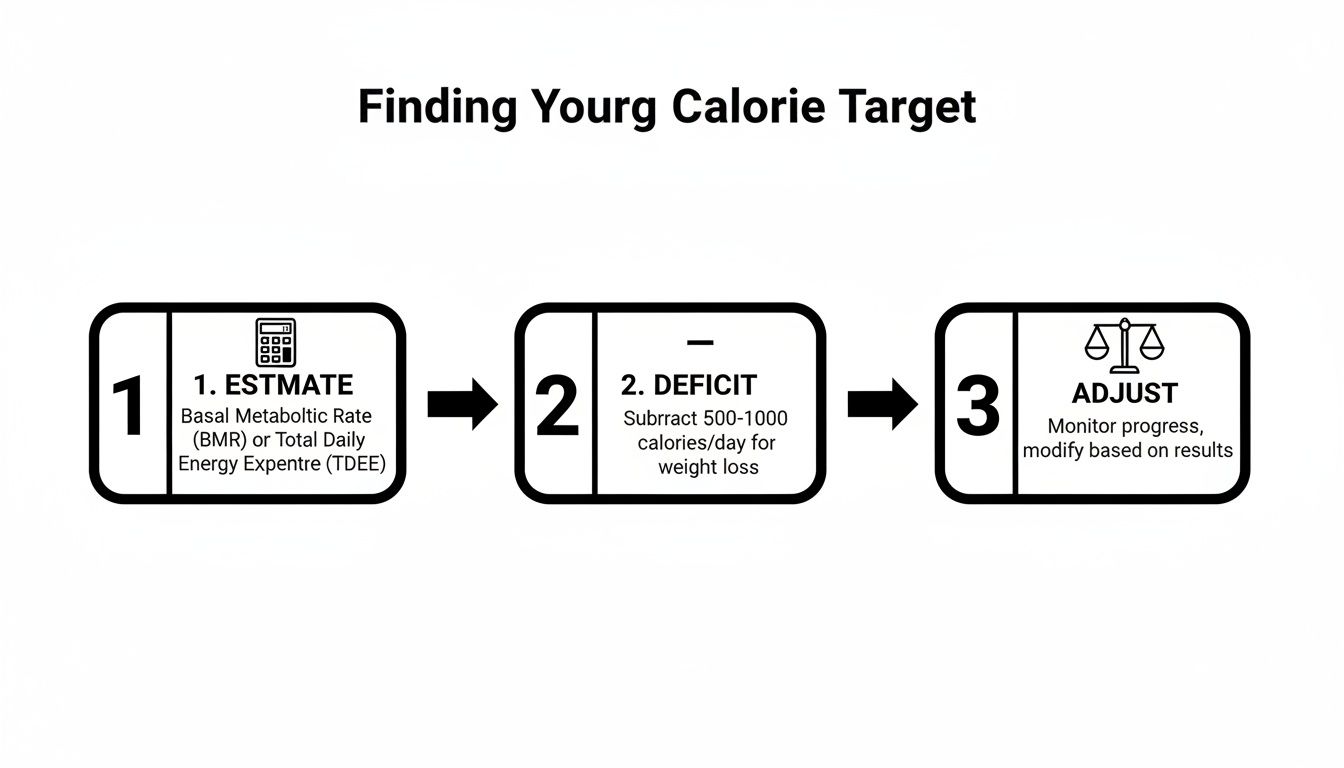
Remember, your initial target is just a starting point. The real magic happens when you listen to your body and adjust as you go.
Whole Foods vs. Processed Foods
The quality of your calories also comes down to how processed they are. Minimally processed whole foods—think fruits, vegetables, lean meats, and whole grains—are packed with the good stuff: vitamins, minerals, and fiber. Your body has to work a bit harder to digest them, which is great for your metabolism and satiety.
Ultra-processed foods are a different story. They're often engineered to be extra delicious, making them incredibly easy to overeat. Stripped of fiber and nutrients, they offer little satisfaction and can trigger even more cravings.
This doesn't mean you can never enjoy a treat! It’s all about balance. By making whole foods the foundation of your diet, you'll find it much easier to stay within your calorie goals while feeling fantastic.
Tracking Your Intake Without the Stress
Let's be honest: the idea of logging every single thing you eat sounds exhausting. It probably brings up images of tedious barcode scanning, measuring cups, and guilt over a handful of chips. But what if tracking wasn't a chore? What if it was just a quick, simple way to check in with yourself, like glancing at your banking app to see where your money’s going?

The goal here isn't perfection or judgment. It’s simply about gaining clarity. You can't make smart adjustments to your "energy budget" if you have no idea what your daily intake looks like. This awareness is the secret ingredient to making a calorie deficit actually work for you in the long run.
Fortunately, we've moved way beyond clunky spreadsheets. Modern tools have completely changed the game, making tracking easier than ever.
Making Tracking Effortless
The biggest roadblock to consistent tracking has always been the sheer effort involved. When you’re juggling work, life, and a million other things, stopping to log every ingredient in your salad is the first thing to get dropped. This is where smarter tech and a more relaxed approach make all the difference.
Imagine just talking to your phone. With a voice-driven app like Munchlog.ai, you can log your meals by simply saying what you ate. No typing, no searching through databases.
- "I had a coffee with oat milk and a banana for breakfast."
- "Lunch was a turkey sandwich on whole wheat with a side salad."
- "My afternoon snack was a handful of almonds and a Greek yogurt."
This turns tracking from an obsessive task into a simple, two-second habit that fits right into your day. You get the valuable data without the headache, shifting the focus from rigid counting to casual check-ins.
Consistency Over Perfection
The only tracking method that works is the one you can actually stick with. Nobody hits their calorie target perfectly every single day, and that's okay. Life is full of office parties, dinners with friends, and days you just really want a slice of pizza.
The real power of casual tracking isn't in hitting a perfect number. It's in building a consistent habit of awareness that empowers you to make small, informed adjustments over time.
This approach helps you avoid the all-or-nothing mindset that derails so many people. If you go over your target one day, it’s not a failure; it’s just data. You see it, acknowledge it, and get right back on track the next day—no guilt required. It’s this flexibility that makes a calorie deficit sustainable. If you're curious about other options, you can explore some of the best nutrition tracking apps that cater to different lifestyles.
Using Data for Insight, Not Judgment
Start thinking of your food log as a friendly source of information. After a week or two of casual tracking, you'll start to see patterns you never would have noticed otherwise.
- Maybe those morning lattes are adding more calories than you realized.
- Perhaps you're not getting enough protein at lunch, which could explain your 3 p.m. snack cravings.
- You might find you eat much healthier on the days you get a good night's sleep.
This is where the magic happens. It’s not about restriction; it’s about arming yourself with knowledge. These insights let you make tiny, strategic tweaks—like adding grilled chicken to your lunch or ordering a smaller latte—that lead to big progress without ever feeling like you're on a restrictive "diet."
Common Calorie Deficit Mistakes to Avoid
Starting a calorie deficit is one thing, but sticking with it can feel like a different beast altogether. It’s incredibly easy to get thrown off course by common myths or small slip-ups, especially when you think you’re doing everything right but the scale isn't moving.
The good news? Most of these hurdles are completely normal and easy to fix. The goal isn’t perfection; it’s awareness. Let’s walk through the most frequent mistakes so you can sidestep the little things that cause so many people to give up.
Cutting Calories Too Drastically
It’s a tempting thought: if a 500-calorie deficit is good, then a 1,000-calorie one must be twice as good, right? Not so fast. In practice, this almost always backfires. When you slash your calories too severely, your body doesn't just burn more fat—it can panic and go into preservation mode.
This overly aggressive approach can kick off a cascade of issues:
- Intense Cravings: Your hunger hormones can go haywire, making it feel nearly impossible to resist the very foods you're trying to limit.
- Energy Crashes: Forget productive workouts or even just feeling sharp at work. You'll likely feel tired, irritable, and completely unmotivated.
- Muscle Loss: When starved for energy, your body doesn’t just pull from fat. It can start breaking down valuable, metabolism-boosting muscle tissue for fuel.
A gentle, sustainable deficit is always the smarter play. Aiming for slow and steady progress of about 0.5 to 1.5 pounds per week is a clear sign you’re on the right track for long-term success.
Forgetting About Liquid Calories
This is probably the sneakiest way extra calories slip into our diets. That morning latte with oat milk and vanilla syrup, the soda you grab with lunch, or that relaxing glass of wine at night can add hundreds of calories to your day without you even realizing it.
Because drinks don't fill you up in the same way food does, it's easy to completely overlook them. This is where casually tracking your intake with a voice-driven app like Munchlog.ai can be a real game-changer. Just saying "I had a large caramel macchiato" gives you instant awareness without the hassle of manual entry.
Relying Too Heavily on 'Diet' Foods
The food industry has certainly caught on to the health trend. In fact, the market for low-calorie foods was valued at an estimated USD 10.10 billion in 2024 and is projected to nearly double by 2034. You can find more details on this growing market on towardsfnb.com.
While some of these products can be useful, many are highly processed and don't offer much in terms of keeping you full. Sure, a 100-calorie snack pack of cookies fits the numbers, but it won't keep you satisfied nearly as long as an apple with a spoonful of peanut butter. Focusing on whole, nutrient-dense foods is a much better strategy for managing actual hunger.
Not Adjusting as You Go
Your body is a master of adaptation. As you lose weight, your metabolism naturally slows down a little—after all, a smaller body simply requires less energy to maintain itself. This means the calorie target that worked wonders for you in the beginning might need a slight adjustment after a few months.
This isn't a sign that you’ve failed or that your metabolism is "broken." It’s a completely normal part of the process! It just means it's time to recalculate your maintenance calories for your new weight and adjust your deficit from there. This simple step is key to breaking through frustrating plateaus and continuing to make progress.
Making It Work in Your Real Life
A perfect nutrition plan on paper is completely useless if it doesn't fit into your actual, messy, wonderful life. Let's be honest, the real secret to long-term success with a calorie deficit isn’t about being perfect—it's about being flexible and consistent. This is where we move beyond the numbers and talk about how to handle the real world, from birthday parties to insanely busy work weeks.
The most important mindset shift you can make is to embrace progress over perfection. Seriously. One off-plan meal or a weekend of celebration doesn't undo weeks of consistent effort. Life is meant to be enjoyed, and that absolutely includes food! The goal is to build healthy habits that can bend without breaking.
Navigating Social Situations
Eating out with friends or heading to a family dinner can feel like a minefield when you're focused on a goal, but it doesn't have to be. With a little bit of strategy, you can stay on track and still have a great time. It’s all about making mindful choices, not depriving yourself.
Here are a few simple tips that make a huge difference:
- Plan Ahead: Take a quick look at the menu online before you go. Having a few good options in mind helps you avoid making a rushed, impulsive decision when you’re hungry.
- Aim for Maintenance: On special occasions, don't even worry about being in a deficit. Just aiming to eat around your maintenance calorie level allows you to enjoy the event without any stress or guilt.
- Focus on Protein and Veggies: When in doubt, build your plate around a lean protein source (chicken, fish, steak) and load up on vegetables. This is a simple trick to feel full and satisfied without accidentally overdoing it.
This kind of flexible approach means you can participate fully in your social life. Go ahead and enjoy that slice of birthday cake, then get right back to your routine the next day. No drama, no guilt—just balance.
Handling Off Days and Plateaus
There will be days when you’re tired, stressed, or just not in the mood to track every little thing. That's completely normal. The key is how you respond. Instead of seeing it as a failure, just view it as a rest day.
An off day doesn't ruin your progress. A week of giving up because of one off day does. Get back to your routine the next day, and you'll find your momentum is still there.
This mindset is crucial for pushing through weight loss plateaus, too. Remember, your body adapts as you lose weight, and what worked for the first 10 pounds might need a little tweak for the next 10. To keep things moving, combining your diet with physical activity is a game-changer. Consider exploring the best low impact workout for weight loss to support your metabolism without putting stress on your joints.
By staying flexible, listening to your body, and being kind to yourself, you turn a temporary diet into a sustainable lifestyle that actually lasts.
Got Questions? We've Got Answers
Let's tackle a few of the most common questions people have when they first start navigating a calorie deficit.
How Long Until I Actually See Results?
This is the million-dollar question, isn't it? While everyone's body is different, a good rule of thumb is that with a steady, moderate deficit of around 500 calories per day, you'll likely start seeing and feeling real changes within 2 to 4 weeks.
But remember, progress isn't just a number on the scale. Keep an eye out for those "non-scale victories"—things like your clothes fitting a little looser, feeling more energetic, or sleeping better. Those are often the first, and most motivating, signs that you’re on the right track.
Is It Possible To Build Muscle While Losing Fat?
Absolutely! It's one of the biggest myths in fitness that you can't do both at the same time. While it takes a smart approach, building muscle in a deficit is totally achievable, especially for those who are newer to strength training.
You just need to get the recipe right. The two most important ingredients are:
- Plenty of Protein: Make sure you’re eating enough protein to give your muscles the raw materials they need to repair and grow stronger.
- Consistent Resistance Training: You have to challenge your muscles to convince your body to keep them around. Lifting weights sends a powerful signal to build and preserve lean mass, even as you're losing fat.
For the best results, stick with a smaller, more conservative deficit. This ensures you have enough fuel in the tank to power your workouts and recover properly.
Do I Have To Track My Food Forever?
Nope, definitely not! Think of food tracking as a set of training wheels. It’s not meant to be a life sentence; it’s a powerful tool to help you learn and build awareness in the beginning.
The real goal of tracking is to develop an intuitive understanding of portion sizes and what’s in the foods you eat regularly. Once that clicks, you've won the long game.
After a few weeks or months, you’ll be surprised at how well you can eyeball portions and make smart choices without logging every single thing. Many people transition away from daily tracking, maybe just checking in for a few days here and there to recalibrate. The ultimate aim is to build habits that feel completely natural.
Ready to stop guessing and start understanding your nutrition the easy way? munchlog.ai lets you track your meals just by talking. No typing, no stress—just simple, voice-powered insights to help you reach your goals. Give it a try and see how effortless food tracking can be!