
How to Read Nutrition Labels Without a PhD
Tired of confusing food labels? Learn how to read nutrition labels with this simple guide. We break down serving sizes, macros, and ingredients for you.
Posted by
 Munchlog
Related reading
The Real Scoop on Calories in Air Fried Chicken Breast
Discover the true calories in air fried chicken breast and learn how simple recipe changes affect your macros. Find out how easy it is to track your meals.
How Many Calories in Bread and Butter? (It's More Than You Think)
Curious about calories in bread butter? This clear guide breaks down the numbers for different bread types and shows you how to track snacks with ease.
What Is a Calorie Deficit? A Stress-Free Guide to How It Works
what is calorie deficit diet: discover how it works, how to calculate your deficit, and tips to start without stress.
Reading a nutrition label doesn't have to feel like studying for a test. When you're in a hurry, you can get all the important info by checking just three things: the serving size, the total calories, and the macros—protein, carbs, and fat. Mastering this quick glance is the first step in turning that confusing block of text into a fast, empowering tool for your food choices.
Your Cheat Sheet for Reading Nutrition Labels
Ever feel a bit lost staring at the back of a package in the grocery aisle? You're definitely not alone. It's easy to get overwhelmed by all the numbers and percentages. But the goal isn't to get bogged down in every detail—it's to have a quick mental checklist that helps you make smart, fast decisions that feel right for you.
Think of it as a quick scan. Whether you're trying to add more protein to your diet, watch your sugar intake, or just be more mindful of snacking habits, the label is your best friend once you know what to look for. This simple 3-step process is all you need to get started.
As the guide shows, it really comes down to three key checkpoints: start with the serving size, glance at the calories, and then check the macros to see what the food is actually made of.
The Big Three of Food Labels
For now, let's ignore all the smaller details. When you’re just getting started, focusing on the most impactful information makes the whole process feel less like a chore. This is especially helpful if you're looking for a simple way to begin tracking your food intake. If you want to learn the fundamentals, our guide on how to track calories is a great place to start.
Here are the three essentials to zero in on:
- Serving Size and Servings Per Container: This is ground zero. All the other numbers on the label are based on one serving, but the package you're holding might contain two, three, or even more.
- Calories: This is a straightforward measure of energy. It gives you an immediate idea of how this food fits into your total energy budget for the day.
- Macronutrients: This is the trio—protein, carbohydrates, and fat—that tells you where those calories come from. Are you grabbing a high-protein snack to stay full, or a carb-heavy treat for a quick burst of energy?
Just by looking at these three things, you can make a quick, informed decision about whether a food is the right fit for you at that moment. It transforms label-reading from a confusing task into a confident check-in that takes less than a minute.
The Nutrition Label at a Glance
To make this even easier, here’s a quick-reference table that breaks down the most important parts of the label for everyday tracking. Think of it as your cheat sheet for the grocery store.
| Label Section | What It Tells You | Why It Matters for Casual Tracking |
|---|---|---|
| Serving Size | The amount the nutrition info is based on. | This is your baseline. If you eat more than one serving, you have to multiply everything else. |
| Calories | The total energy in one serving. | Helps you manage your daily energy intake and stay on track with your personal goals. |
| Macronutrients | The breakdown of protein, carbs, and fat. | Shows you the quality of the calories and helps you balance your meals. |
This table covers the absolute must-knows. By focusing on these three sections, you get 80% of the important information in 20% of the time, making healthy choices simple and sustainable.
The Serving Size Secret Everyone Misses
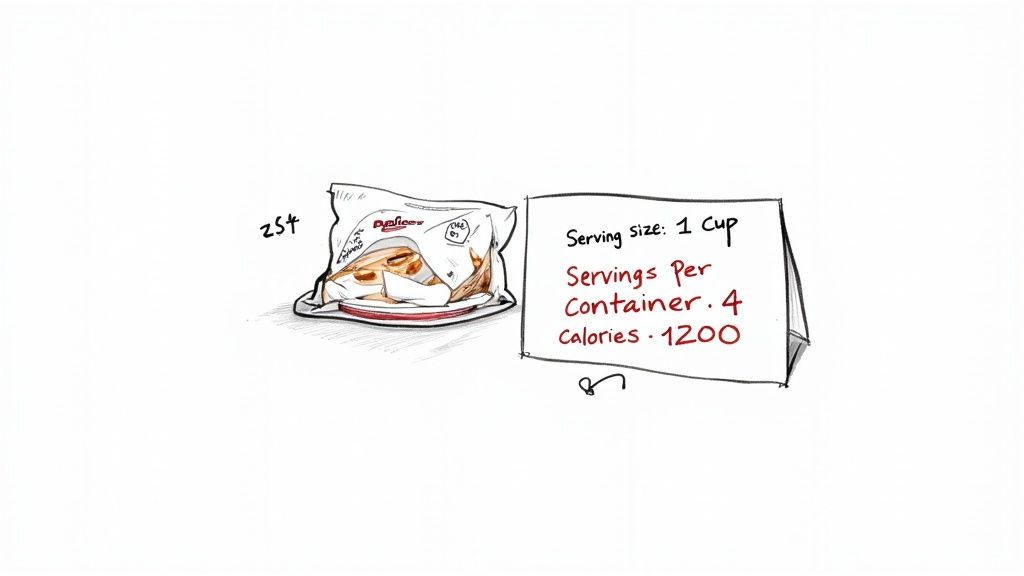
We've all been there. You grab what looks like a single-serving bag of chips or a small carton of ice cream, finish it in one sitting, and then happen to glance at the label. That's when you see it contained four servings. Suddenly, your innocent 150-calorie snack was actually a 600-calorie event.
This is exactly why the very first place your eyes should go on a nutrition label is the Serving Size. It’s the key that unlocks the meaning of every other number on that panel. Without understanding the serving size first, the calorie count and macro breakdown are completely out of context.
Food manufacturers can be a bit sneaky here. A bottle of iced tea might seem like one drink, but the label could reveal it’s "2.5 servings per container." This is probably the most common pitfall people run into, and it can throw off your tracking without you even realizing it.
Why Servings Per Container Matters Most
Think of "Servings Per Container" as your reality check. It’s the multiplier for everything else on the label. If you plan on eating the whole package, you have to multiply the calories, fat, protein, and carbs by that number to get the real total.
This isn't about feeling guilty for eating more than one serving—let’s be honest, it happens. It's about being aware so you can make an informed choice.
Here’s a classic example:
- A protein bar lists 200 calories per serving.
- The package contains two bars.
- The "Servings Per Container" says 2.
If you eat both bars, you haven't consumed 200 calories. You've consumed 400 calories and doubled all the other macros along with it. This quick check can make a massive difference in how accurately you track your daily intake.
Mastering the habit of checking the serving size first is a total game-changer. It’s the one step that ensures your food logs are a realistic reflection of what you actually ate, not just what you thought you ate.
A Simple Mental Trick for Quick Math
You don't need to pull out a calculator every time you eat. Just do a quick mental multiplication. If a serving of trail mix is 170 calories and the bag has three servings, a quick estimate tells you the whole thing is around 500 calories. That rough math is usually more than enough to keep you on track.
When you use an app like Munchlog, knowing the serving size makes your voice logs much more accurate. Instead of just saying, "I ate a bag of pretzels," you can say, "I ate a bag of pretzels, it was three servings." This simple addition gives the AI the context it needs, making your tracking effortless and precise without you ever having to do the math yourself. It’s all about being aware, not obsessive.
Making Sense of Calories and Macros
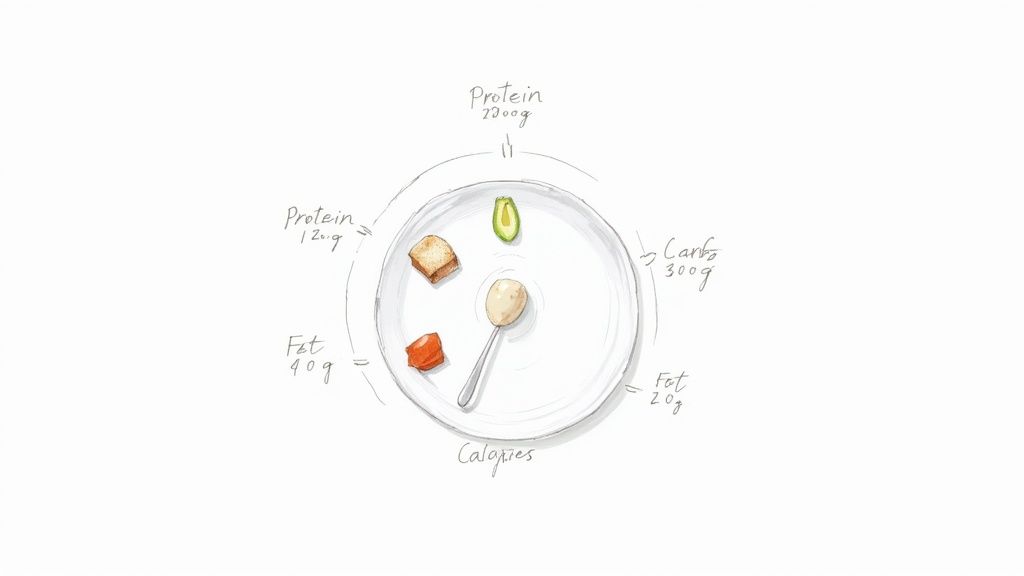
Alright, once you've figured out the serving size, the next logical stop is the calories and macronutrients. This section is where you get the real story behind a food's energy profile. I like to think of calories as the total fuel your body gets, while macros tell you exactly what kind of fuel it is.
You don't need a degree in nutrition to figure this part out, especially if you're just tracking casually. The key is to focus on the "big three" macros listed right below the calorie count: Total Fat, Total Carbohydrate, and Protein. These are the fundamental building blocks of everything we eat.
Understanding this breakdown helps you pick foods that actually align with what your body needs at that moment. Are you looking for a quick burst of energy before hitting the gym? Or do you need something to keep you full and focused through a long afternoon of meetings? The macro section has the answers.
Calories as Your Energy Guide
Let's start with calories. They're just a unit of energy, plain and simple. That big, bold number tells you how much energy you'll get from one serving of that food. It's a great starting point, but it's not the whole picture. A 200-calorie snack loaded with protein and fiber will hit your system very differently than a 200-calorie snack full of sugar.
This is exactly why you have to look beyond the calorie count. A quick scan of the macros gives you the context you need to make a genuinely informed choice. It’s no surprise that studies show people who regularly check nutrition labels often have healthier eating habits. They tend to pay close attention to calories, sugars, and serving sizes to guide their choices. If you're interested in the data, you can explore the research on dietary patterns and see how these habits connect to overall diet quality.
Decoding the Macronutrients
Macros are what give calories their personality. Each one plays a unique role in your body, and getting a handle on them is easier than it seems. If you want to dive deeper, we have a whole guide on what macronutrients are and see some examples.
For now, here’s a quick-and-dirty breakdown:
- Total Fat: This is your source for sustained energy and is critical for things like hormone production. It's also the most calorie-dense macro, which is why a little bit can go a long way in making you feel satisfied.
- Total Carbohydrate: Think of carbs as your body's preferred, quick-access fuel source. This number on the label includes everything from dietary fiber (great for digestion) to sugars.
- Protein: Protein is essential for building and repairing tissues, from muscles to skin. Foods high in protein are famous for helping you feel fuller for longer—a huge advantage when you're trying to manage hunger.
Here's a real-world example I see all the time: A granola bar and a protein bar might have nearly identical calorie counts. But the granola bar is probably packed with carbs for that quick energy hit, while the protein bar is designed to keep you feeling full. Neither one is "bad"; they just serve completely different purposes.
Knowing this lets you make strategic decisions. Need to power through that 3 p.m. slump? A snack with a solid mix of protein and healthy fats is probably a better bet than a carb-heavy option that might leave you crashing an hour later. And tracking it doesn't have to be a chore. Just tell your app something like, "I had a high-protein yogurt for a snack," and a smart tool like Munchlog will know what you mean without you having to nitpick every number. It’s all about being mindful, not perfect.
Understanding Percent Daily Value and Added Sugars
Let's tackle that column of percentages on the far right: the % Daily Value, or %DV. It can look a little intimidating, but it’s actually one of the most useful shortcuts on the entire label for making quick, smart decisions without getting lost in the weeds.
Think of it as a quick reference guide. The %DV shows you how much a nutrient in a single serving contributes to a general 2,000-calorie daily diet. Even if your personal calorie needs are higher or lower, this percentage gives you an instant feel for whether a food is high or low in something.
It completely simplifies questions like, "Is this a lot of sodium?" You don't have to memorize how many milligrams of fat or fiber you should be getting; the percentage does the heavy lifting for you.
The 5/20 Rule: Your Go-To Shortcut
The easiest way to put the %DV into practice is with the 5/20 rule. This is a simple mental trick that makes grocery store decisions so much faster.
Here’s the basic idea:
- 5% DV or less of a nutrient per serving is considered low.
- 20% DV or more of a nutrient per serving is considered high.
This rule is incredibly practical. For things you want to limit—like saturated fat, sodium, and added sugars—you should generally look for foods with a low %DV. On the other hand, for nutrients you want more of, like dietary fiber, vitamin D, and calcium, grabbing foods with a high %DV is a great strategy.
Let's say you're comparing two cans of soup. One has a whopping 45% DV of sodium, while the other has 15%. That %DV instantly flags the first one as a sodium bomb, making your choice obvious without having to compare the actual milligram counts.
A great way to visualize this is by thinking about which nutrients you want to "spend" your daily budget on.
A Quick Guide to Percent Daily Value
This simple table breaks down how to use the 5/20 rule to your advantage.
| Nutrient | Aim for Low %DV (<5%) | Aim for High %DV (>20%) |
|---|---|---|
| Saturated Fat | ✅ | |
| Sodium | ✅ | |
| Added Sugars | ✅ | |
| Dietary Fiber | ✅ | |
| Vitamin D | ✅ | |
| Calcium | ✅ | |
| Iron | ✅ | |
| Potassium | ✅ |
So, you're generally trying to get less of the nutrients at the top of the label and more of the ones toward the bottom.
Decoding the "Added Sugars" Line
One of the best updates to the nutrition label in recent years was the addition of the "Added Sugars" line. This is a total game-changer because it finally separates the sugars that are naturally part of a food (like the lactose in milk or fructose in an apple) from the sugars that are dumped in during processing.
Why does this matter so much? Natural sugars usually come packaged with other good stuff like fiber, vitamins, and minerals. Added sugars—the kind you find in sodas, cookies, and many flavored yogurts—are what we call "empty calories," offering energy but almost no other nutritional value.
This isn't about villainizing sugar or trying to eliminate it completely. It's simply about being aware of where it’s coming from. A little bit of added sugar here and there is no big deal, but it adds up surprisingly fast. Keeping an eye on this number puts you in control. And if you’re tracking, it’s easier than ever. You can just tell an app like Munchlog "I had a vanilla yogurt," and its AI can estimate the added sugars for you, making casual logging a breeze.
Reading the Ingredient List Like a Detective
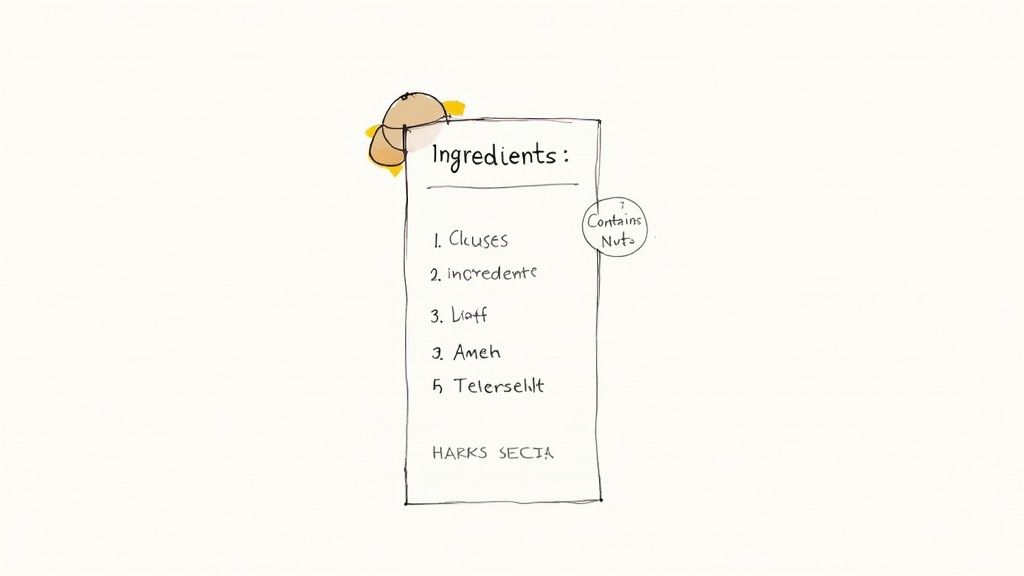
Alright, you've crunched the numbers—calories, macros, the works. Now it’s time to peek behind the curtain at the ingredient list. This is where you find out what your food is actually made of, beyond the flashy marketing claims on the front of the box.
The single most important thing to remember here is that ingredients are always listed by weight, from most to least. The first ingredient is the main component, and the last one is present in the smallest amount. This simple rule is incredibly powerful once you start applying it.
Honestly, this one fact can be a total game-changer. You might grab a cereal that screams "healthy," but a quick glance at the ingredients shows sugar is listed second, right after whole grain oats. Suddenly, you realize it's more of a sweet treat than a powerhouse breakfast, which helps you make a much more informed choice.
What to Look for First
When you’re just getting the hang of this, don't feel like you need to decipher every multi-syllable chemical name. That’s overwhelming. Instead, focus on a few key things that give you the biggest bang for your buck. The point isn’t to label foods with long lists as "bad," but to become a smarter, more aware consumer.
Here's what I always look for first:
- The First Three Ingredients: These make up the bulk of the product. Are they whole foods you recognize—things like "whole wheat flour," "chicken," or "almonds"? Or are they different forms of sugar, refined flours, and processed oils?
- Multiple Types of Sugar: Food manufacturers are clever. They often use several different sweeteners (like high-fructose corn syrup, dextrose, and cane juice) to prevent "sugar" from being the very first ingredient. If you see a few of these sprinkled throughout the list, you can bet the product is much sweeter than it seems.
- Familiar vs. Unfamiliar Ingredients: A good rule of thumb is to lean towards foods with ingredients you could imagine having in your own kitchen. It's not a foolproof system, but it's a great shortcut for finding less processed options.
This isn't about aiming for perfection or creating a "banned" list of ingredients. It's simply about building awareness. The more you understand what's in your food, the better you can align your choices with your health goals and how you want to feel.
Spotting Allergens and Sensitivities
For anyone with food allergies or sensitivities, the ingredient list is absolutely non-negotiable. The good news is that the FDA requires the eight major food allergens to be clearly declared.
You’ll usually find this information in a separate “Contains” statement (e.g., "Contains: Wheat, Milk, and Soy") or highlighted in bold text right within the ingredient list itself. This makes it incredibly easy to do a quick safety check.
This part of the label is also your best friend if you're navigating specific dietary needs, like finding vegan or gluten-free products. For example, if you're picking out a protein supplement, the list will instantly tell you if it's whey-based (from milk) or uses a plant source. If you need some solid recommendations, our article on vegan and gluten-free protein powders can help point you in the right direction. Knowing how to read the ingredients is what truly empowers you to find products that fit your life perfectly.
Your Questions on Nutrition Labels Answered
Even after breaking down the label piece by piece, a few tricky questions always seem to pop up. Let's tackle some of the most common ones so you feel completely confident next time you're in the grocery aisle.
Think of this as your quick-reference guide for handling any label that comes your way. My goal is to clear up any lingering confusion—deciphering a label shouldn't feel like a pop quiz, but a simple, empowering step in knowing what you're eating.
What Is the Difference Between 'Sugar-Free' and 'No Added Sugar'?
This is a fantastic question because the two sound so similar but mean very different things.
A product labeled "sugar-free" is a regulated claim. It means the item has less than 0.5 grams of sugar per serving. It's a very specific, low threshold.
On the other hand, "no added sugar" simply means that no sugar was added during processing. This is a big one to watch out for, because the product could still be naturally high in sugar from ingredients like fruit or milk. A carton of plain yogurt is a great example—it has no added sugar, but it still contains natural lactose (milk sugar).
How Do I Track Food Without a Label?
From the fresh croissant at your local coffee shop to the apples you grab at the farmers market, plenty of foods don't come with a standard nutrition label. So, what do you do?
The answer is simple: estimation is your best friend.
For something like a bakery muffin, just find a similar item in a food database. The goal for casual tracking is consistency, not clinical perfection. Making a reasonable guess and logging it is always more effective than skipping it entirely because you don't have the exact numbers.
For items you eat often, like your morning coffee with a splash of cream, you only need to figure it out once. After that, it becomes an easy, repeatable log entry. It's all about building simple habits.
What About Supplements and Vitamins?
Beyond food packaging, understanding the nuances of supplement labels is another valuable skill for making informed health decisions. These labels can have their own unique terms and structures.
If you're looking to expand your knowledge in this area, there are great guides that explain how to read supplement labels without needing a science degree.
Should I Only Count Net Carbs?
You’ll often see "net carbs" marketed on low-carb or keto-friendly products. This number is calculated by subtracting fiber and certain sugar alcohols from the total carbohydrates.
For most people who are just casually tracking their food, focusing on "Total Carbohydrates" is simpler and gives a more complete picture of what you’re eating. Unless a specific diet requires you to track net carbs, sticking to the total is a perfectly effective and much less complicated approach for staying mindful of your intake.
Ready to make tracking what you eat as easy as talking? munchlog.ai uses voice recognition to log your meals effortlessly. No more typing, no more scanning barcodes—just speak what you ate and let our AI handle the rest. Start your journey to mindful eating today at https://munchlog.ai.